
Water Storage Dams

Water Storage Applications
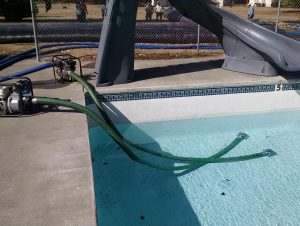
60000 gal Water Storage for Pool MaintenanceAquaDams® are used for temporarily storing on-site water within the dam for a variety of purposes. The patented design provides extensive water storage capacity and will hold more water within a given space than the same space filled with cylindrical tanks. AquaDam® material is suitable for contact with drinking water.

AquaDams can be utilized in water storage applications including:

  • General water storage
  • Fire protection
  • Storage during contamination testing

Request a Quote

Real-World AquaDam® Water Storage Applications

AquaDams are regularly and successfully used for water storage projects. Some past successes include:

  • SeaWorld: An AquaDam® water-storage farm using (20) 4ft tall, 250ft long AquaDam® water storage units, stored saltwater from the tank of Shamu the killer whale at the SeaWorld facility in Aura, Ohio. The AquaDam® water storage units held the water during the retrofitting and painting of the tank. The water was pumped back into the tank from the AquaDam® upon the project’s completion.
  • Wildlife water reservoir: In 2004, the California Department of Fish & Game utilized an AquaDam® to create a water reservoir to serve as a fish habitat. The storage dam helped alleviate problems caused by low-water conditions that led to an unhealthy environment for the area’s aquatic life.
  • Irrigation water storage: A Fruitland Ridge, CA, a grape-growing operation used AquaDams® to store water used for irrigation purposes after local wells ran dry. The project entailed connecting two AquaDams via a connection collar. Each storage dam was self-supporting and could hold up to 10,000 gallons of water. The water was delivered with the aid of a pump inserted into the dam.
  • Radioactivity testing: In the early 1950s, a reactor core accident at a nuclear facility in Pennsylvania resulted in contamination of the water supply. AquaDams were used continually to store runoff water for testing and treatment before releasing it into a local stream. The 6’x50′ storage dams held up to 20,000 gallons of water during the 48-hour testing period. This water storage unit was in continuous use for over 5 years.

Contact AquaDam to Learn More About the Water Storage Benefits of AquaDams

Learn more about how an AquaDam® can provide the ideal solution for your next water storage project. Contact AquaDam online for additional information or call 800-682-9283 for a quote today.

Learn More Today!

Frequently Asked Questions

What are common water storage applications for AquaDams?

AquaDams serve as flexible, temporary water storage solutions across diverse industries. Common applications include emergency fire protection reserves for construction sites or industrial facilities, temporary storage during water system maintenance or contamination testing, irrigation water storage for agricultural operations, temporary potable water reserves, and wildlife habitat creation during low-water seasons. Real-world examples demonstrate versatility: SeaWorld used 20 units to store saltwater during facility retrofitting, California Department of Fish & Game created temporary fish habitat during drought, agricultural operations stored irrigation water when wells failed, and nuclear facilities used them for 48-hour radioactive testing cycles continuously for years.

Is the AquaDam material safe for water storage?

Yes—AquaDams are specifically designed for water storage. The patented design uses food-grade, high-quality polyethylene materials that meet stringent water quality standards. The construction (water-tight polyethylene tubes) prevents most contamination and maintains water purity for both short-term emergency reserves and extended storage periods. This makes AquaDams suitable for emergency water reserves, disaster response scenarios, municipal water system backup, and any application where water storage might be of concern. It is possible to store potable water in an AquaDam, but at this time AquaDams are not manufactured for potable water for human consumption.

How much water can a single AquaDam hold, and what factors affect capacity?

AquaDam water storage capacity depends on dimensions (height and length) and configuration. The patented design provides extensive storage in a compact footprint—AquaDams hold more water in a given space than cylindrical tanks of equivalent dimensions. A 4-foot by 250-foot AquaDam holds approximately 52,500 gallons; a 10-foot by 50-foot AquaDam holds approximately 50,000 gallons. Capacity scales linearly with length. Multiple units can be connected end-to-end or side-by-side to achieve larger storage volumes. Above ground ponds can be created using AquaDams, for an open body of water application. Site footprint, available space, and water supply limitations are primary factors determining optimal configuration. Custom sizing is available.

How long can water be safely stored in an AquaDam, and what maintenance is required?

Water can be stored for extended periods depending on application and water source. For most applications AquaDams maintain water quality indefinitely provided the system remains sealed and protected from contamination and debris. Maintenance requirements are minimal: periodic inspection for tears, leaks, damage, and geotextile integrity, debris removal from dam surface, protection from sharp objects and vandalism. In one nuclear facility example, AquaDams maintained integrity and water quality for continuous operation over 5 years with standard maintenance, demonstrating long-term durability.

What is the cost and setup timeline for AquaDam water storage vs. permanent tanks?

AquaDams offer significant economic advantages for temporary storage needs. Setup is rapid—typically 1–4 hours from delivery to fully operational storage, compared to weeks or months for permanent tank installation. Capital costs are substantially lower than rigid tanks: a 4-foot by 250-foot AquaDam (52,500 gallons) costs a fraction of an equivalent permanent tank while offering superior space efficiency and portability. For temporary applications (emergency response, seasonal storage, testing periods), AquaDams eliminate capital expense of permanent infrastructure used intermittently. They’re easily relocated to different sites, require no installation modifications, and incur minimal labor costs. Organizations needing flexible storage capacity typically achieve 40–60% cost savings compared to permanent tank alternatives.

AquaDam