Dewatering With AquaDam

Construction sites must be completely dry before initiating a building project. That’s why many construction companies rely on dewatering — the process of removing ground or surface water — to prevent ponding. 

Water-filled cofferdams help maintain dry-land environments by isolating work areas. This process allows for dewatering in construction projects and other industrial applications.

AquaDam® Work Area Isolation for Dewatering Support
Humboldt Bay Levee Breach Plug

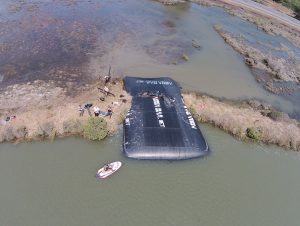
AquaDam® water-filled cofferdams isolate job sites to allow for dewatering in construction. These solutions comprise a patented tube-in-sleeve structure with a vertical baffle to create a lightweight yet stable barrier. AquaDams are a cost-effective alternative to sandbags that take a fraction of the time to deploy and remove. These heavy-duty barriers remain in place, qualifying them as protective devices according to the Clean Water Act. 

AquaDams comprise a flexible polypropylene and polyethylene blend. They conform well to irregular ground surfaces without water seepage except beneath the cofferdam. How much seepage occurs underneath the barrier depends on ground conditions.

AquaDams are available in lengths of up to 1,200 feet and boast patented connection collars that join two AquaDams together.

Request a Quote

Construction Dewatering Applications

While cofferdams are ideal for construction site isolation, these solutions support dewatering in many applications: 

  • Pond liner repair
  • Bridge abutment work
  • Canal construction and repair
  • Box culvert isolation
  • River bank revetment
  • Pipeline inspection, construction and repair
  • Bridge pier inspection and repair
  • Sewage treatment plants
  • Boat ramp construction, demolition and repair
  • Special projects

How AquaDams Have Aided in Construction Site Dewatering

AquaDams have been successful in many industrial projects.

Artificial Lagoon Isolation and Phase-In

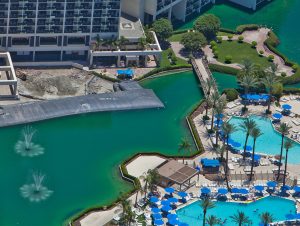
AquaDams have been used nearly constantly from 2016 to the present to support the world’s largest Crystal Lagoon located in Mohammed Bin Rashid Al Maktoum City, District One in Dubai. The cofferdams used for this project measured 16 feet tall, 300 feet long and 12 feet tall, 150 feet long.

AquaDams were chosen for the artificial lagoon project because they would not introduce sediment into the water or damage the expensive poly liner.

Hydropower Intake Construction and Demolition

In 2013, Sandbar Flat Dam near Sonora, California, used two 16-foot-tall, 300-foot-long AquaDams for their two-phase project. In phase one, the cofferdams isolated the bank where the new hydropower intake would be built. In phase two, the AquaDams isolated the old intake’s mouth so it could be demolished, enabling Pacific Gas and Electric to minimize power production loss.

Water Intake Canal Gate Replacement

In 2012, 21-, 16- and 10-foot-tall AquaDams measuring approximately 120 feet long were installed at the mouth of the water intake canal in Lake Independence, near Truckee, California, which supplies drinking water to Reno, Nevada. With the help of the AquaDams, workers could isolate and dewater the intake canal, allowing them to replace the century-old gate structure. 

Palm Desert Pond Intake Construction

AquaDams were used to isolate a corner of a holding pond in Palm Desert, California, in 2018 to allow contractors to build a new pump intake structure while the rest of the pond remained in operation. This project used a 12-foot-tall, 270-foot-long AquaDam® and two support AquaDams measuring eight feet tall.

Get Dewatering Support for Construction Sites

Achieve work area isolation and support dewatering with AquaDams. The cofferdam flood barriers provide reliable water control without the weaknesses of traditional alternatives.

Contact us for a quote on an AquaDam® today!


Frequently Asked Questions

What types of construction dewatering projects use AquaDams?

AquaDams are used across diverse dewatering applications including dredging, pond liner repairs, bridge abutment work, canal construction and repair, box culvert isolation, river bank revetment, pipeline inspection/construction/repair, bridge pier inspection and repair, sewage treatment plants, boat ramp construction/demolition/repair, and special engineering projects. The versatility comes from the ability to isolate work areas and create completely dry work zones—allowing construction to proceed in conditions that would otherwise require expensive underwater equipment or hazardous diving operations.

How do AquaDams isolate a work areas for dewatering construction sites?

AquaDams create temporary water-tight barriers that isolates construction work zones. An AquaDam can be positioned around the work area, while filled with the on site water creating a stable temporary barrier. After the AquaDam is full and in position the water inside the isolated zone is then pumped out, creating a completely dry work environment. This allows construction crews to work safely on exposed surfaces, use standard land-based equipment (bulldozers, excavators, loaders), and maintain clear visibility of the work area. Once construction is complete, the work area is re-watered, the AquaDam is drained and removed, and the process leaves no permanent impacts.

Can you provide specific examples of major dewatering projects using AquaDams?

Yes, several major projects demonstrate AquaDam dewatering capabilities: (1) Crystal Lagoon in Dubai (2016-present)—Using 16-foot and 12-foot tall AquaDams for complex lagoon isolation and construction; (2) Sandbar Flat Dam, California (2013)—Two 16-foot-tall, 300-foot-long AquaDams isolated the hydropower intake for construction; (3) Lake Independence Water Intake, California (2012)—Using 21-foot, 16-foot, and 10-foot-tall AquaDams for complex gate replacement; (4) Palm Desert Pond Intake, California (2018)—12-foot and 8-foot-tall AquaDams isolated water intake construction. These projects demonstrate AquaDams handling complex, large-scale dewatering scenarios.

What are the advantages of AquaDam dewatering compared to traditional methods?

AquaDam dewatering offers multiple advantages: (1) Allows work to continue in adjacent areas while isolated zone is dewatered. There is no project-wide shutdown required; (2) Enables use of cost-effective standard construction equipment instead of specialized underwater work gear; (3) Improves worker safety by eliminating underwater hazards and providing clear working conditions; (4) Reduces project timeline by allowing efficient land-based construction methods; (5) Maintains water control and environmental compliance during all phases; (6) Scalable from small culvert repairs to massive dam projects requiring 16-foot-tall AquaDams spanning hundreds of feet.

What factors determine the right AquaDam configuration for a dewatering project?

Key factors include: (1) Depth of water to be controlled over the lifetime of the project (AquaDams control up to 75% of their height, in ideal conditions); (2) Size and shape of the work area (linear, rectangular, curved); (3) Soil and ground stability conditions where the AquaDam is installed; (4) Duration of dewatering needed (affects pumping frequency and equipment requirements); (5) Existing water flows that must be diverted or managed; (6) Environmental permits and water discharge requirements; (7) Construction timeline constraints; (8) Equipment access for installation and operation. Consulting with AquaDam specialists ensures optimal configuration for your specific dewatering scenario.

AquaDam