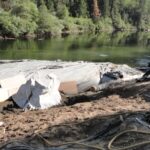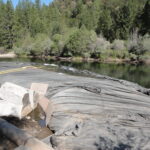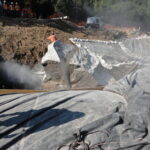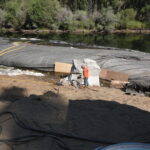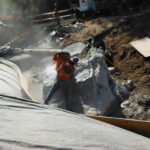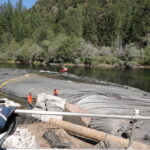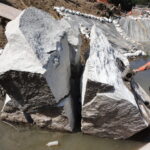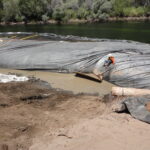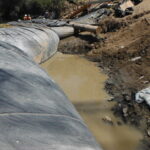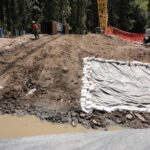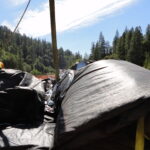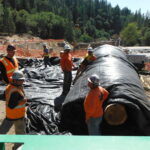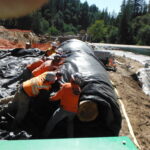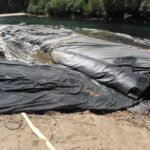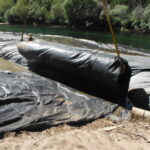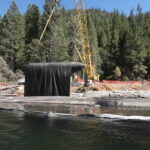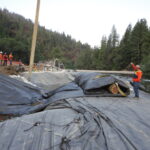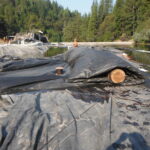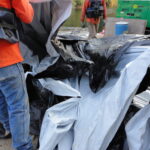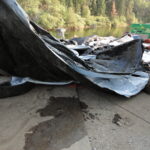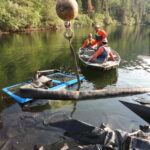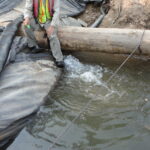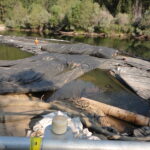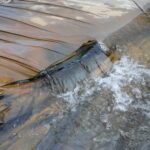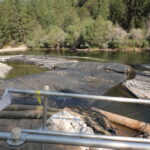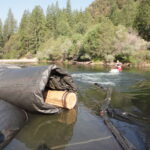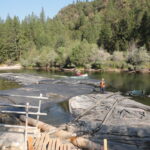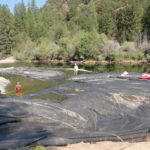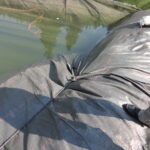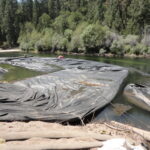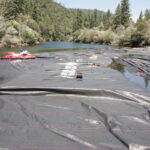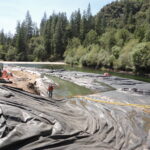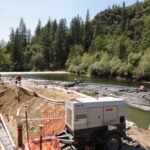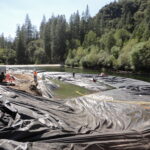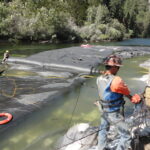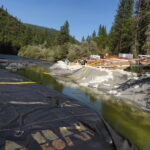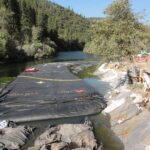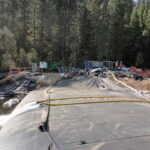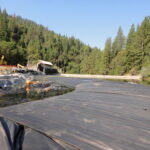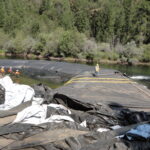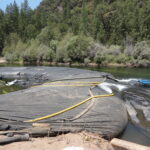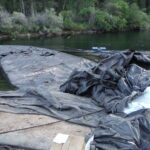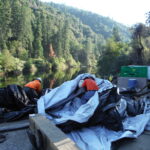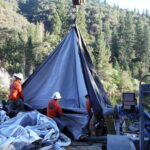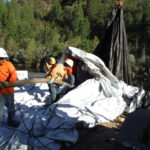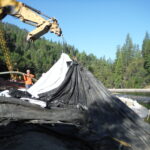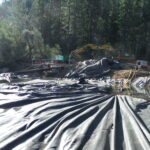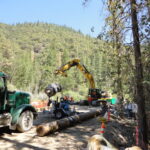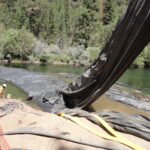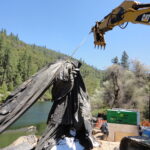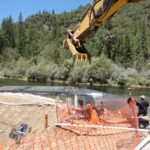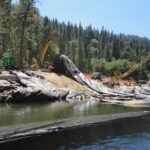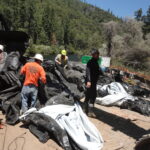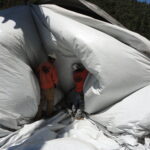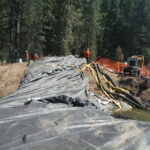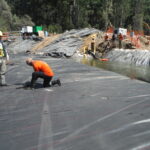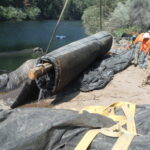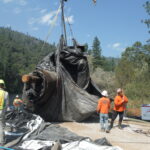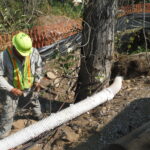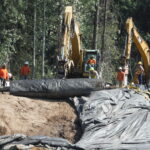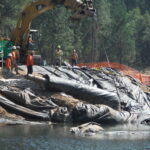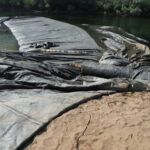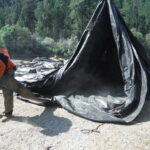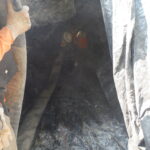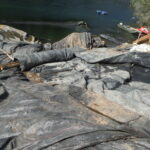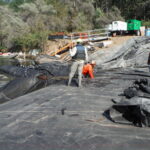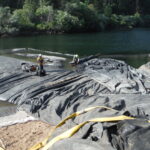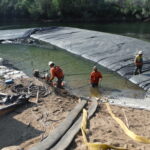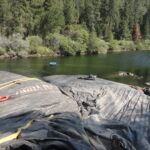

Approximately one month after the riverbed sealing skirt was installed, Aqua Dam® Inc. returned to the Middle Fork of the Stanislaus River. The large boulder located beneath the tree, previously positioned at the end of the 16ft tall double closed end (DCE) AquaDam, was now visibly split down the middle.
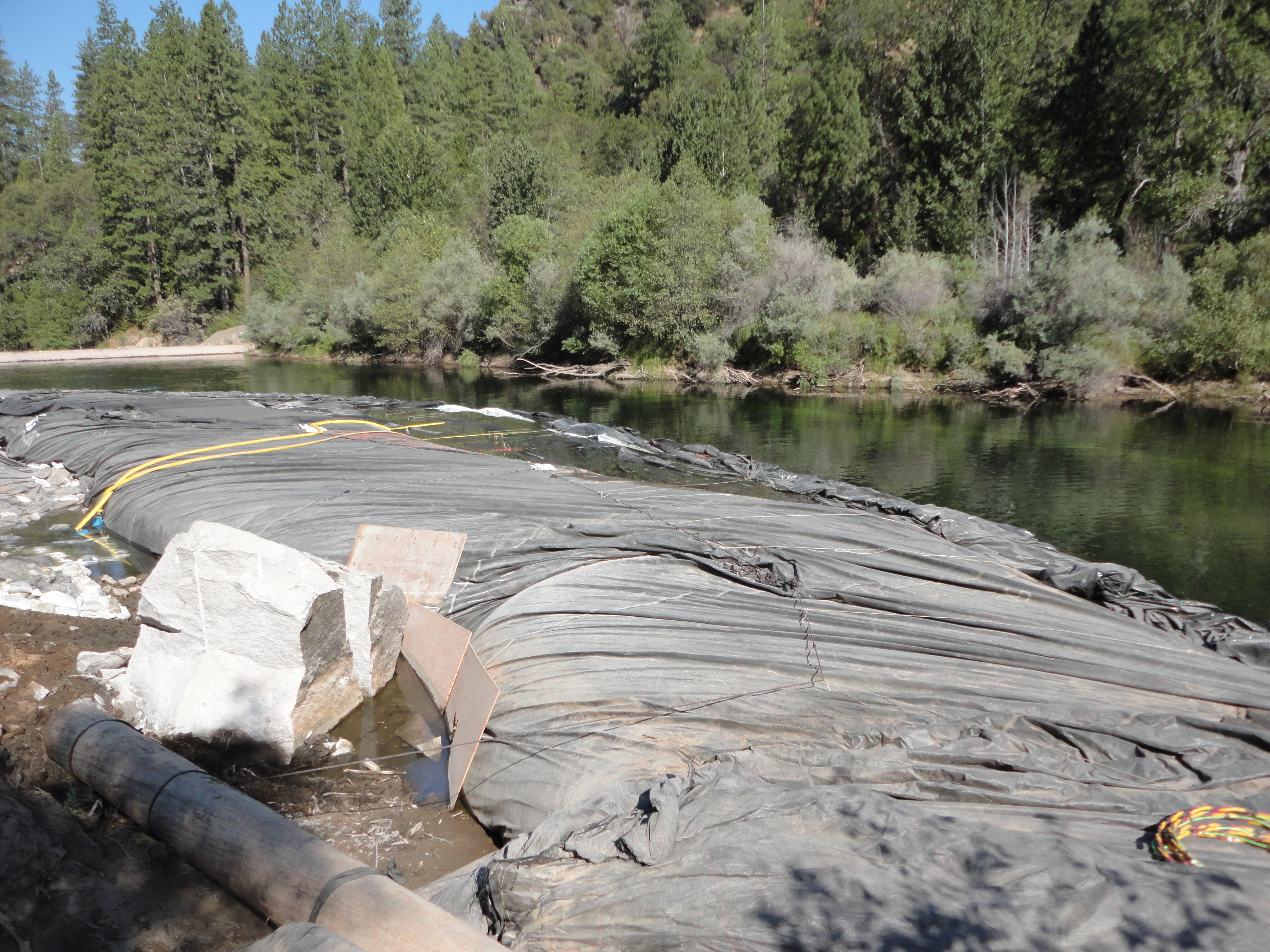
To secure the skirt atop the AquaDam®, several hundred sandbags filled with angular aggregate were utilized. Over time, the movement of these bags caused mechanical abrasion against the AquaDam’s outer woven textile. This resulted in minor punctures that eventually propagated into significant tears, leading to the unveiling of the outer layers. Despite this external degradation, the inner tubing along the shoreline remained intact, maintaining its hydraulic seal and water retention.
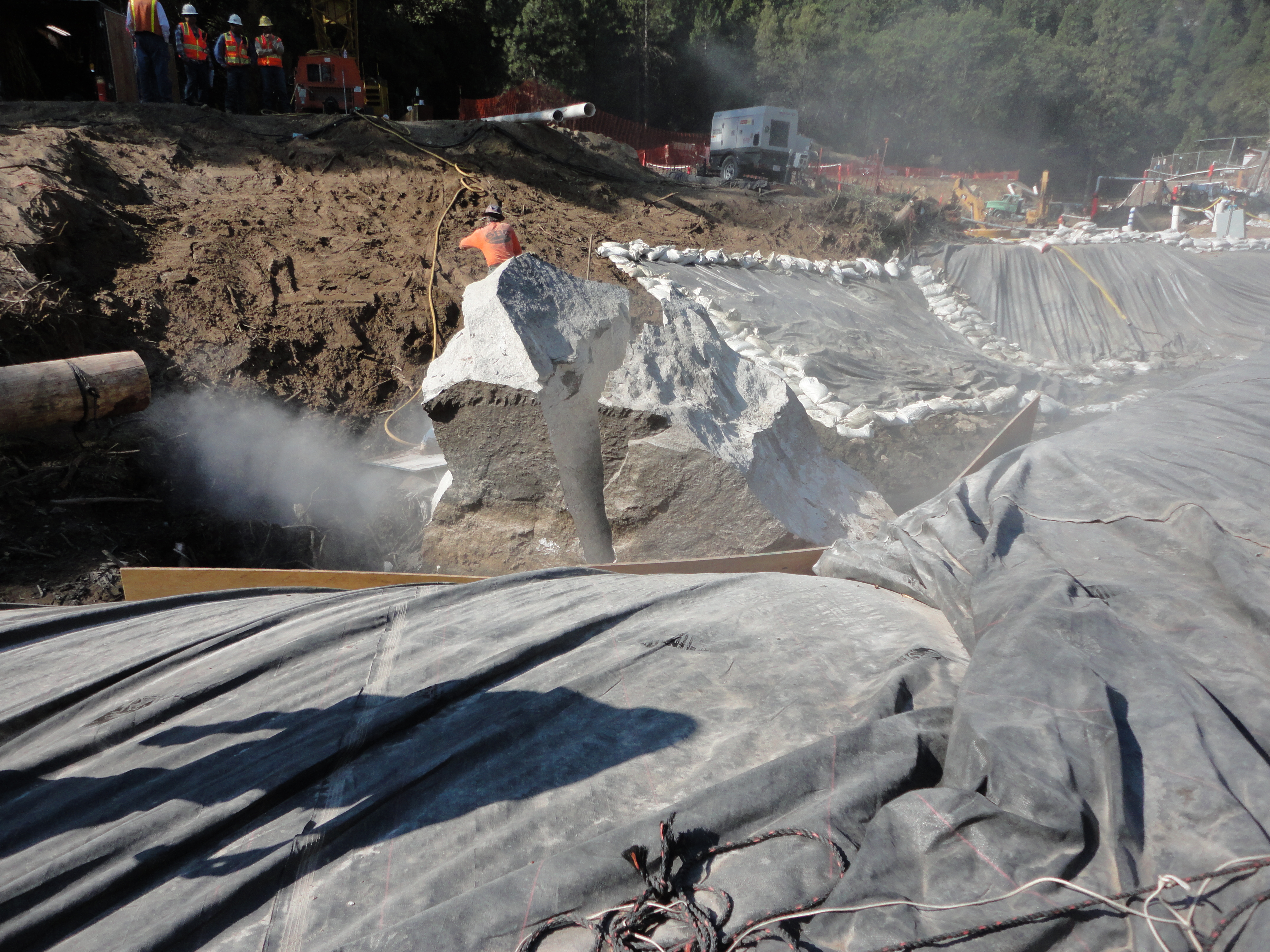
The decision was made to remove the large boulder. To accomplish this, the crew needed to break it into smaller sections so it could be safely and efficiently removed.
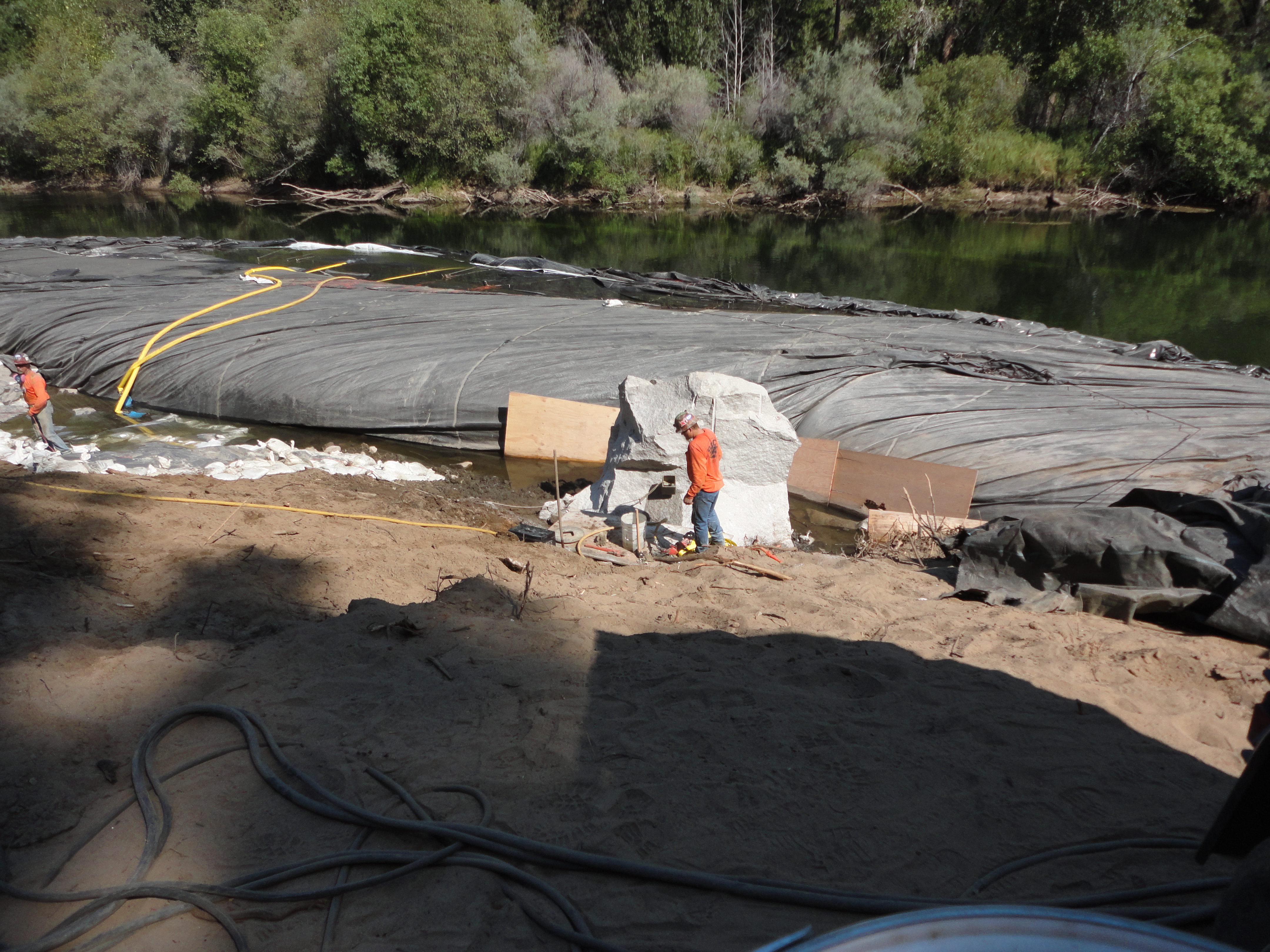
Site personnel drilled a borehole and deployed a controlled explosive charge to facilitate the fragmentation of the massive boulder. This procedure was necessary to reduce the rock to manageable segments for efficient removal.
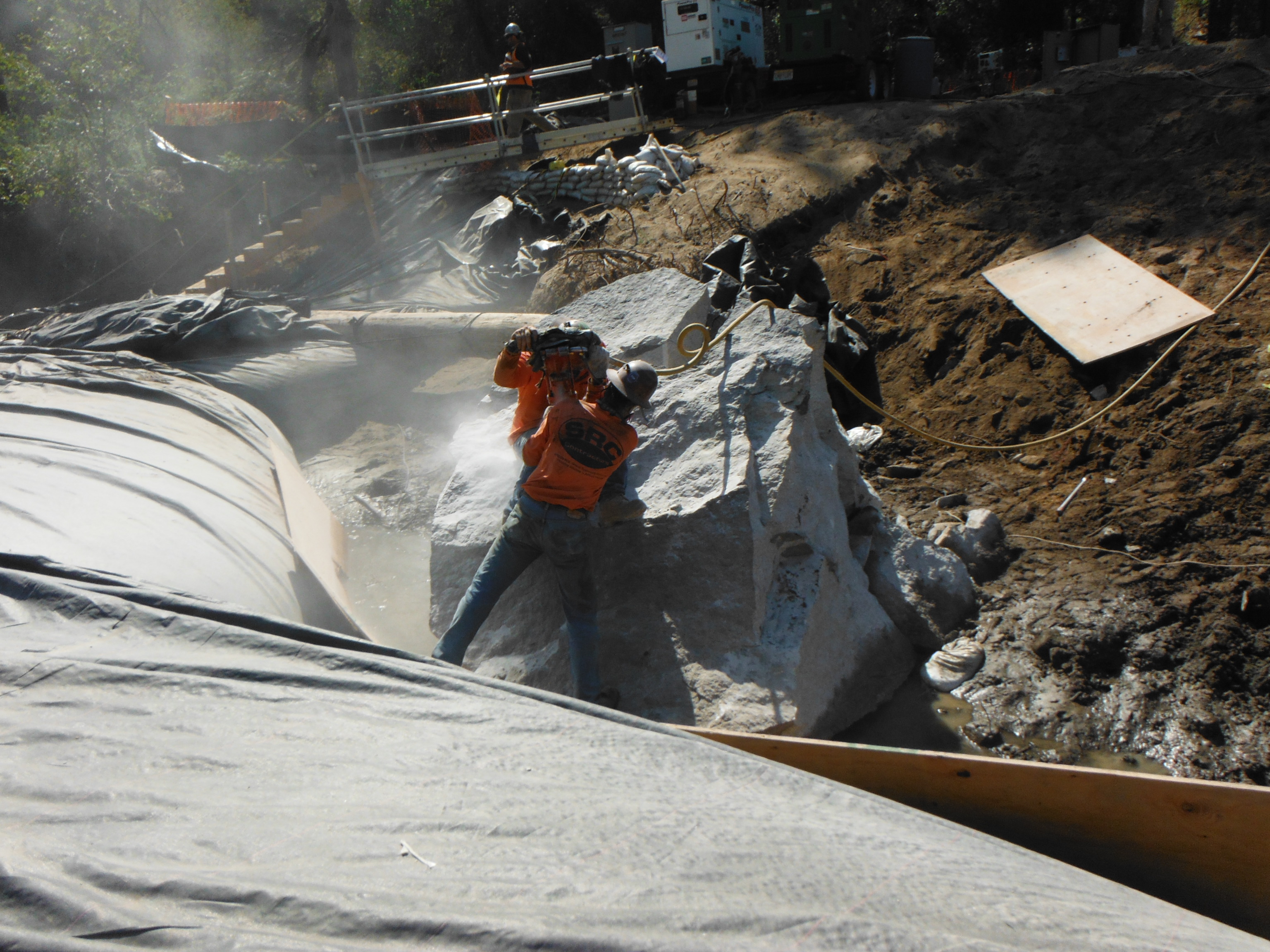
Due to the scale of the obstruction, multiple boreholes and subsequent explosive charges were required to achieve sufficient fragmentation. This iterative process reduced the mass into manageable debris for removal from the riverbed.
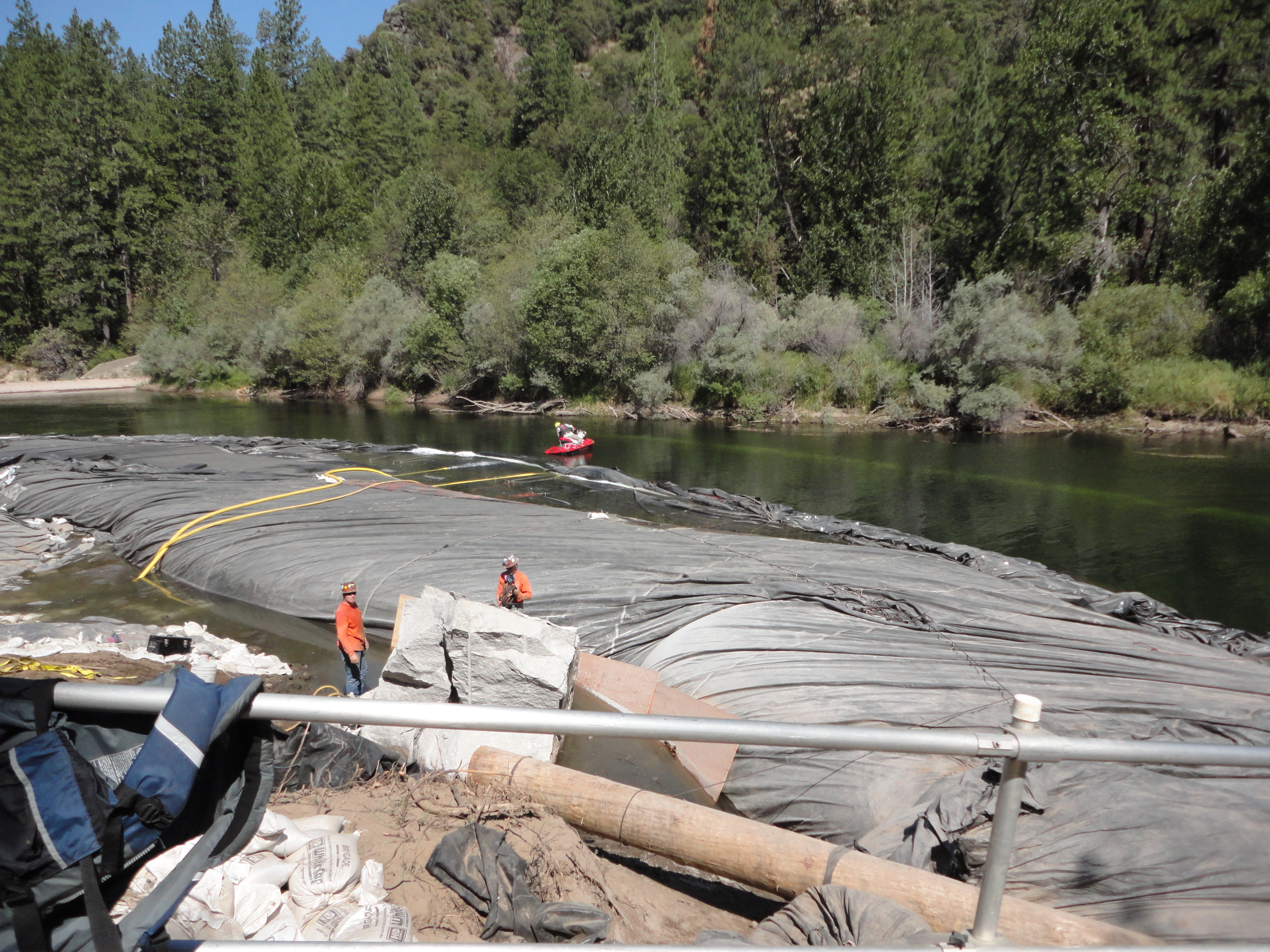
To mitigate the risk of damage during fragmentation, the crew installed plywood sheeting as a protective barrier between the boulder and the AquaDam®. This shielding prevented the angular edges of the debris from causing further abrasion or compromising the dam’s outer membrane.
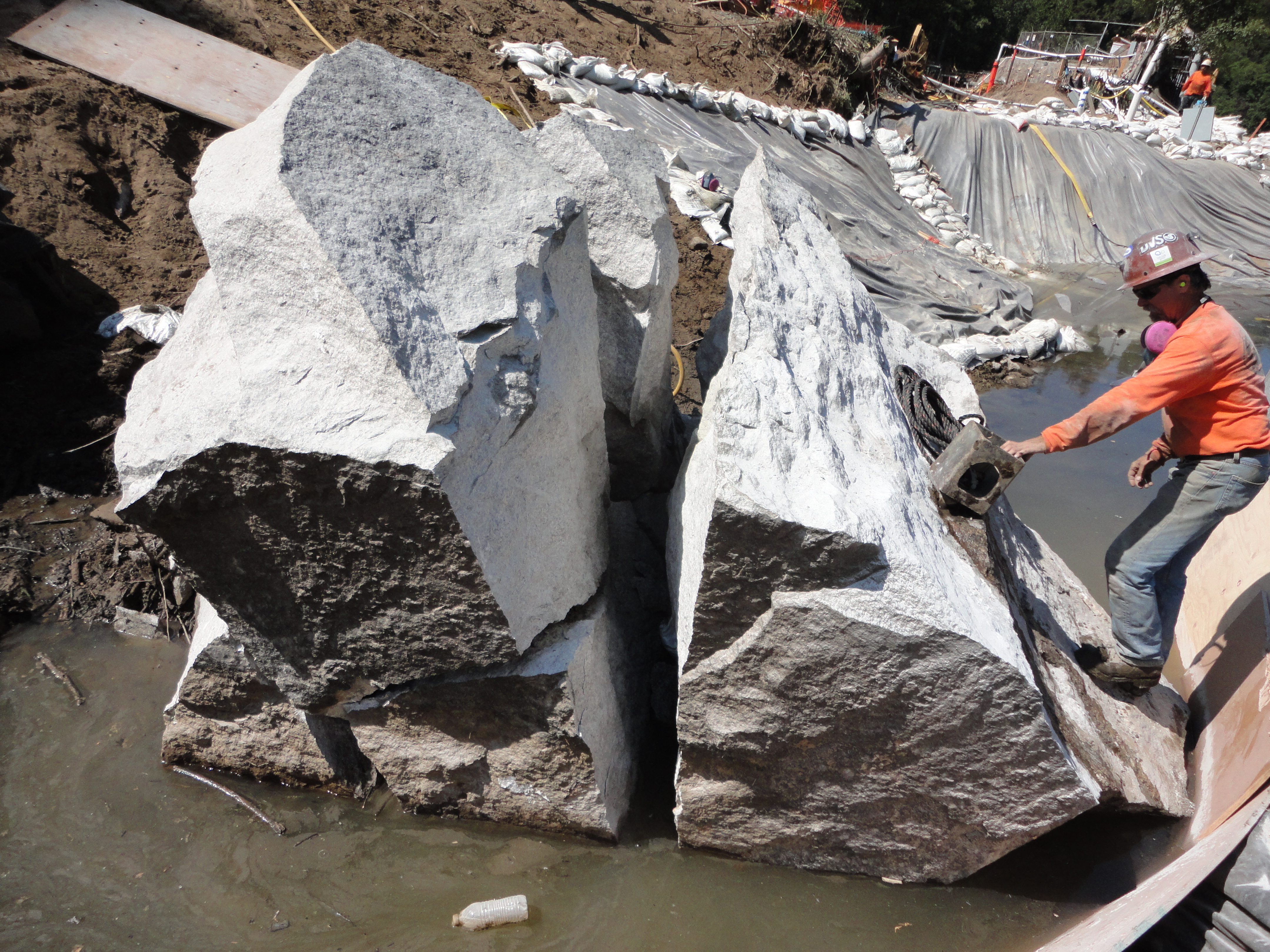
The massive granite boulder needed to be broken into smaller, transportable pieces. The crew had to carefully position themselves to safely and effectively drill the required holes.
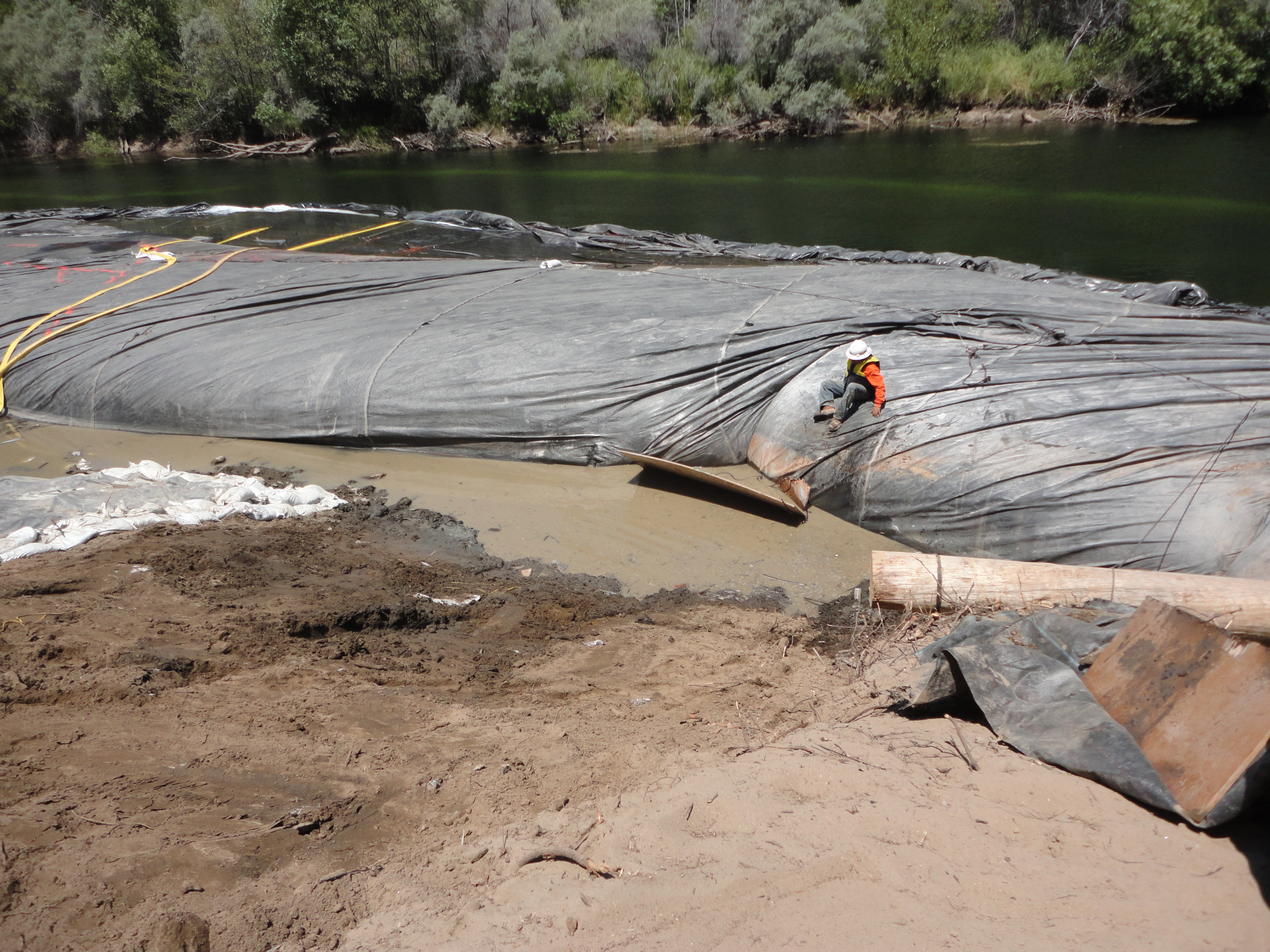
The boulder was successfully broken apart and fully removed. Once the debris was cleared, the crew retrieved the plywood sheets that had been placed earlier to protect the AquaDam® from sharp edges.
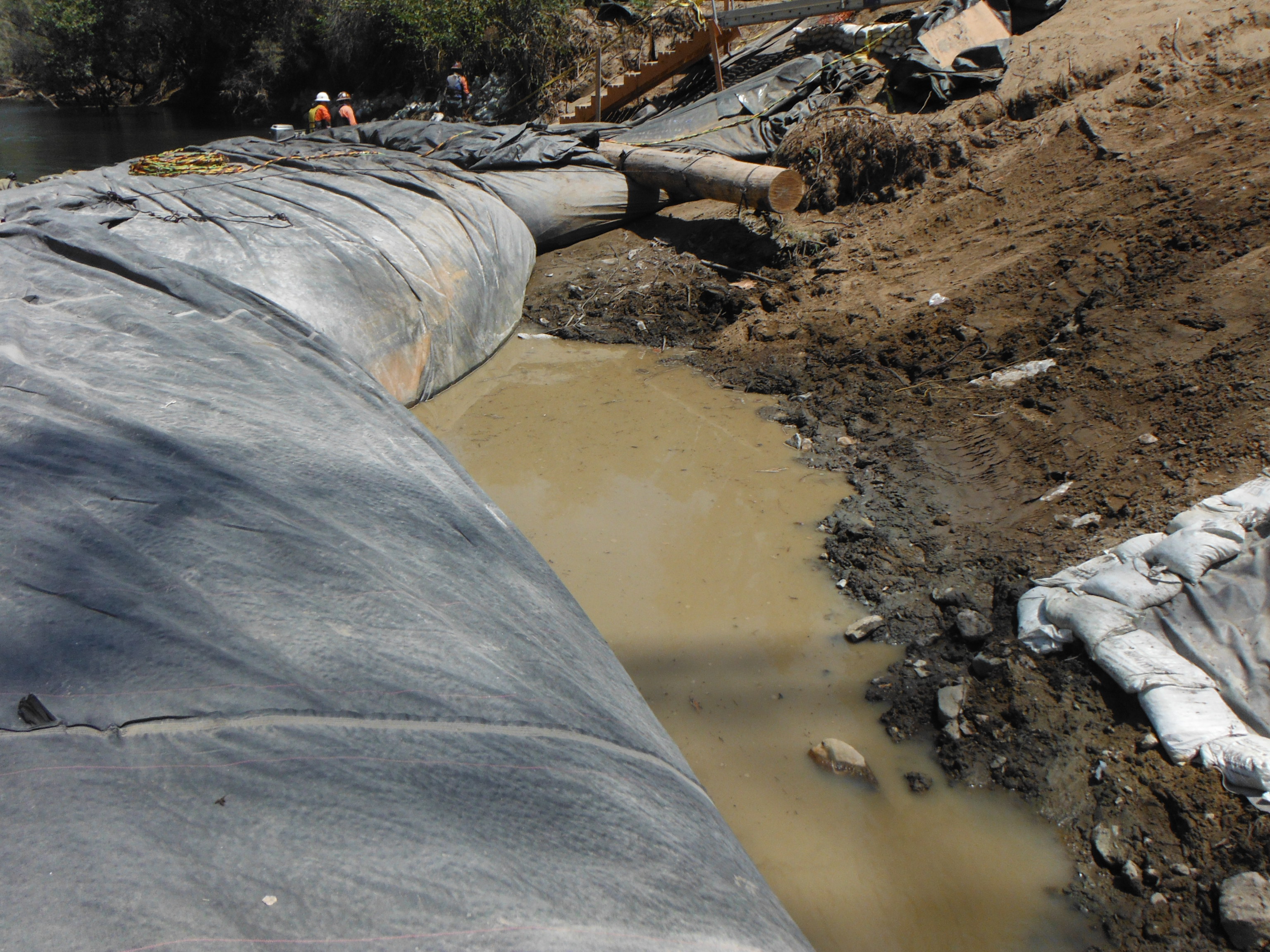
With the geological obstruction successfully cleared, an unobstructed path has been established for the deployment of the replacement AquaDam®. The incoming unit, a single closed end (SCE) model measuring 16ft high, 33ft wide (when fully filled), and 300ft in length, is now ready to be staged for installation.
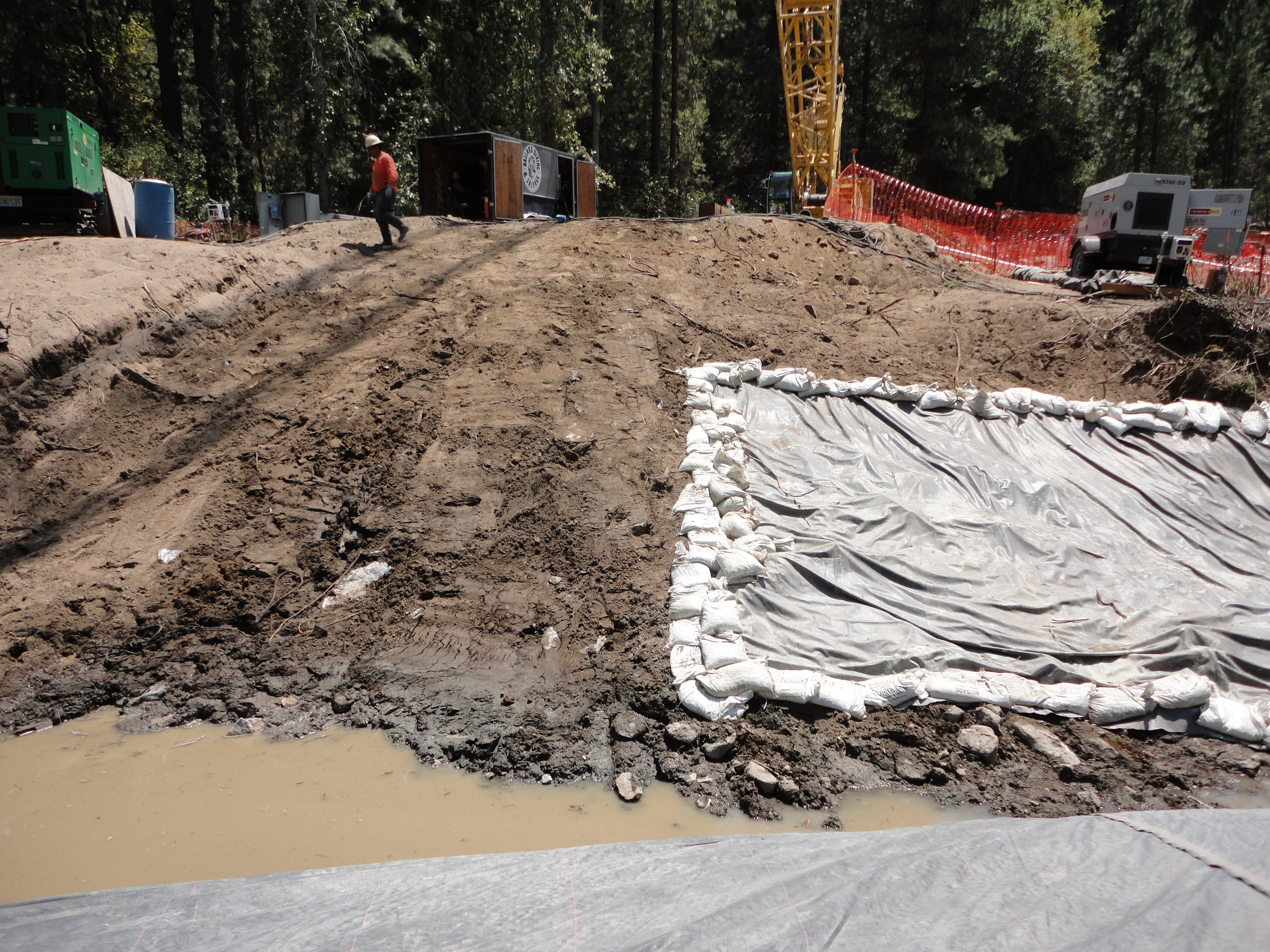
The open end of the 16ft tall SCE AquaDam® will be secured at the location where the worker is standing to ensure it remains in place.
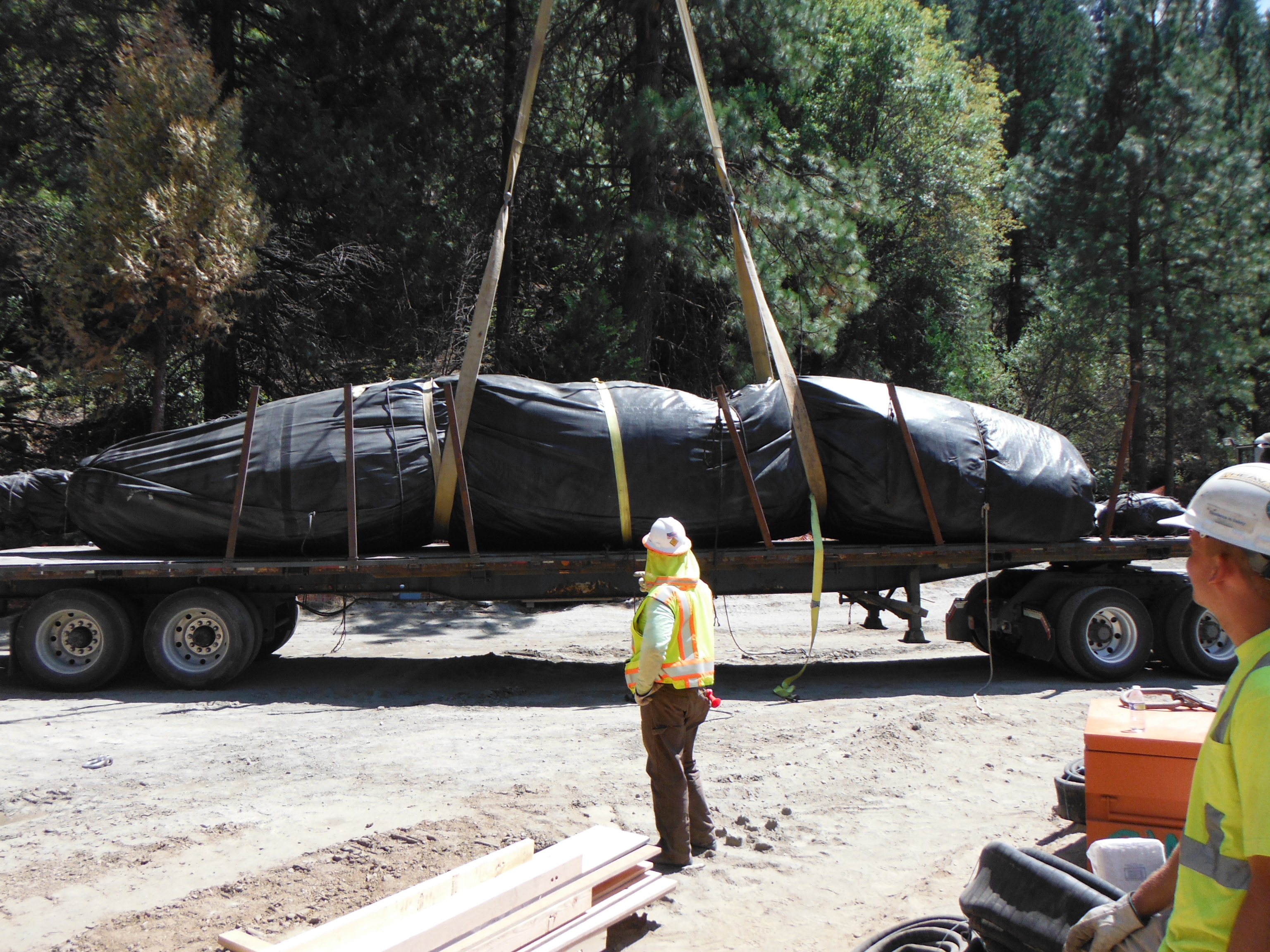
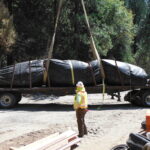
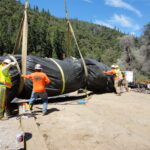
The 16ft tall, 300ft long SCE AquaDam® has arrived on site and is being unloaded from the flatbed trailer used for transport. AquaDams® are delivered rolled up, similar to a large carpet, around a wooden beam. Each unit is carefully wrapped in protective material and equipped with lifting straps to facilitate safe and efficient handling.
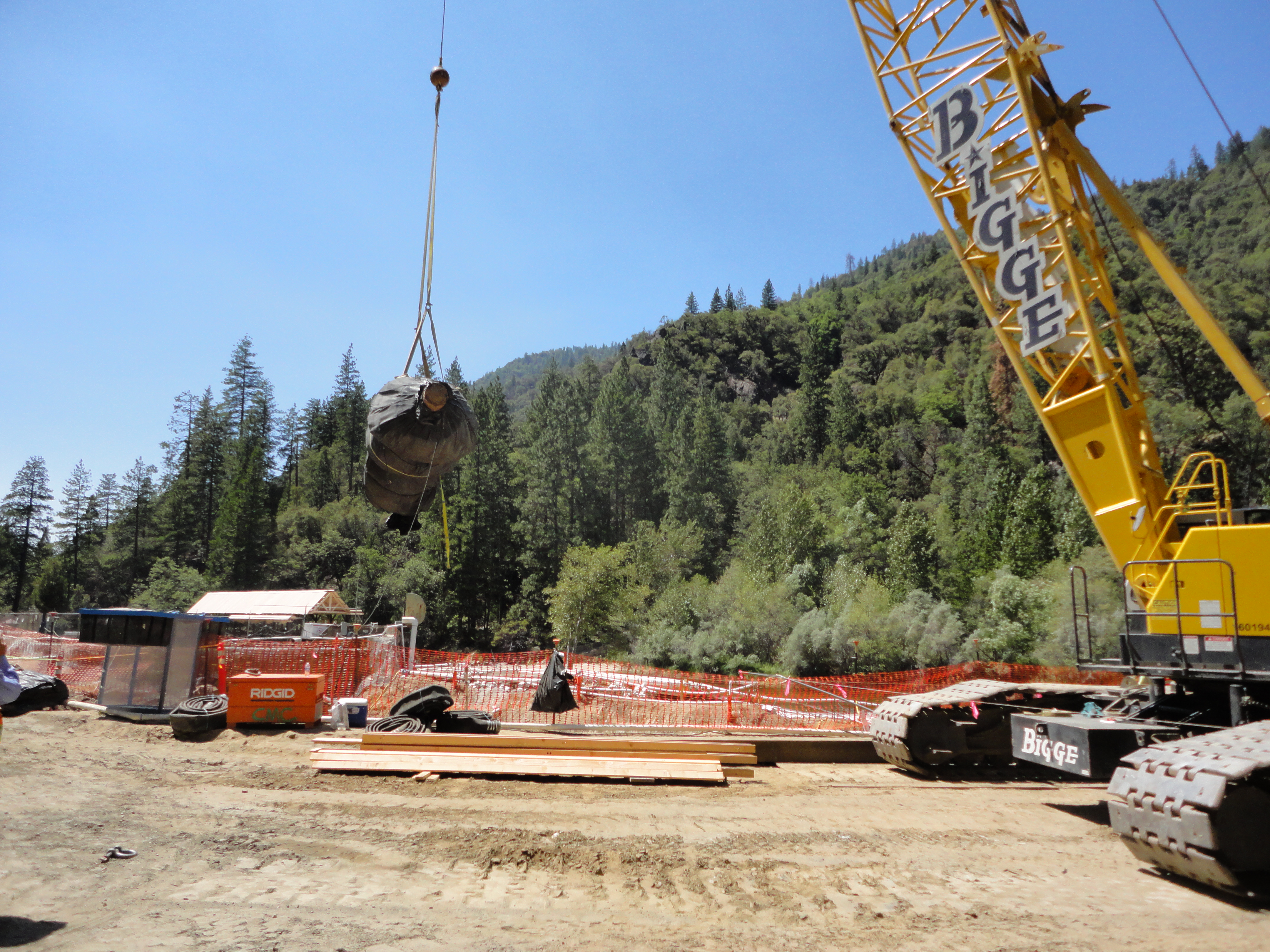
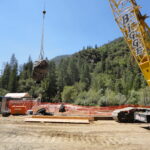
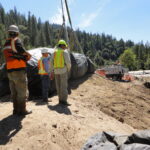
A crane was used to unload the AquaDam® and position it at its designated starting bank.
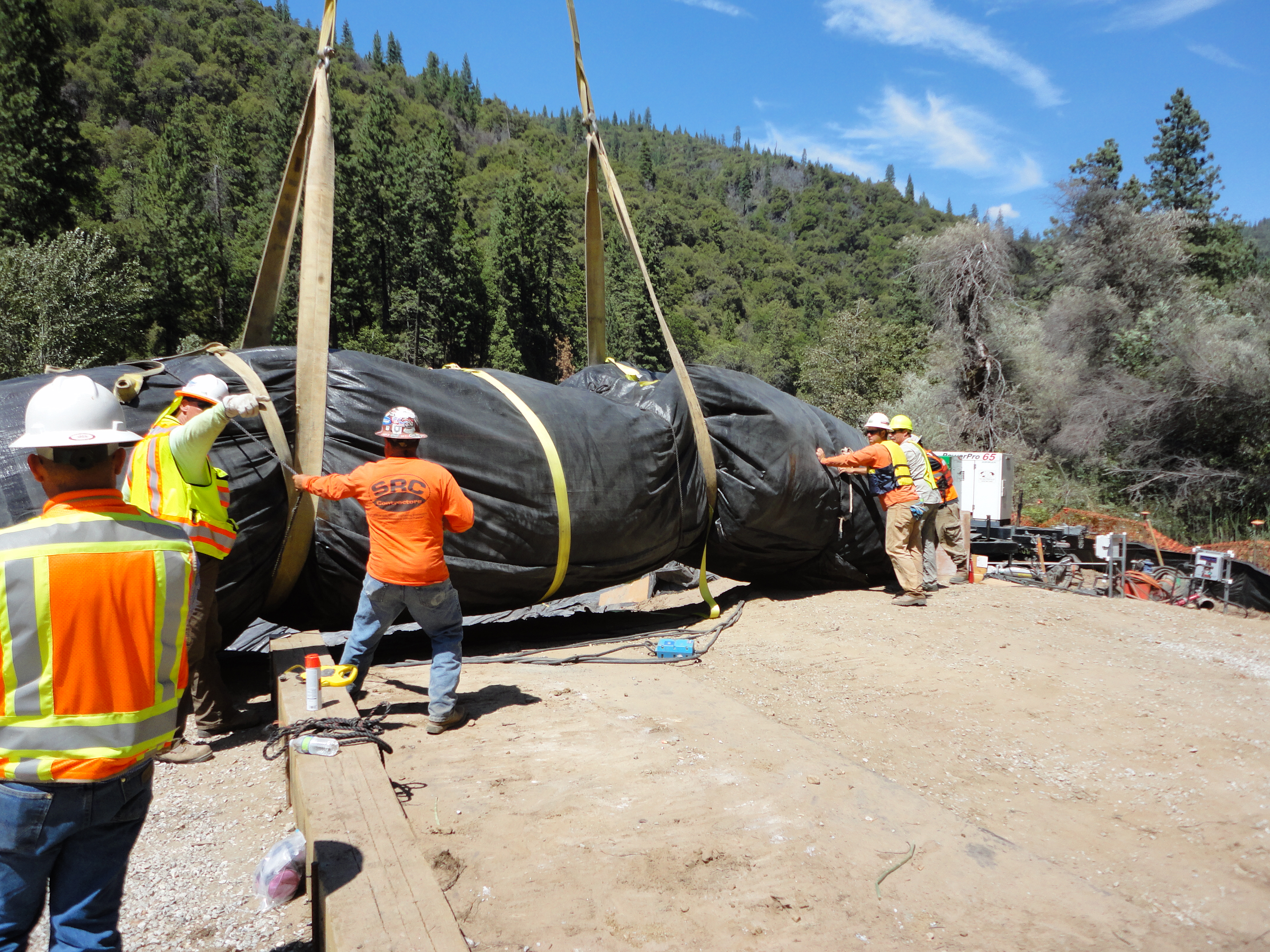
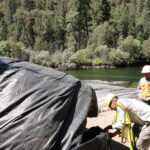
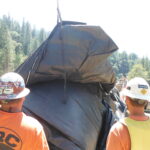
Once the AquaDam® was positioned over the starting bank, the crew oriented the rolled unit in the correct direction. The protective covering is clearly labeled with the dam’s dimensions and includes directional arrows indicating the proper unrolling orientation.
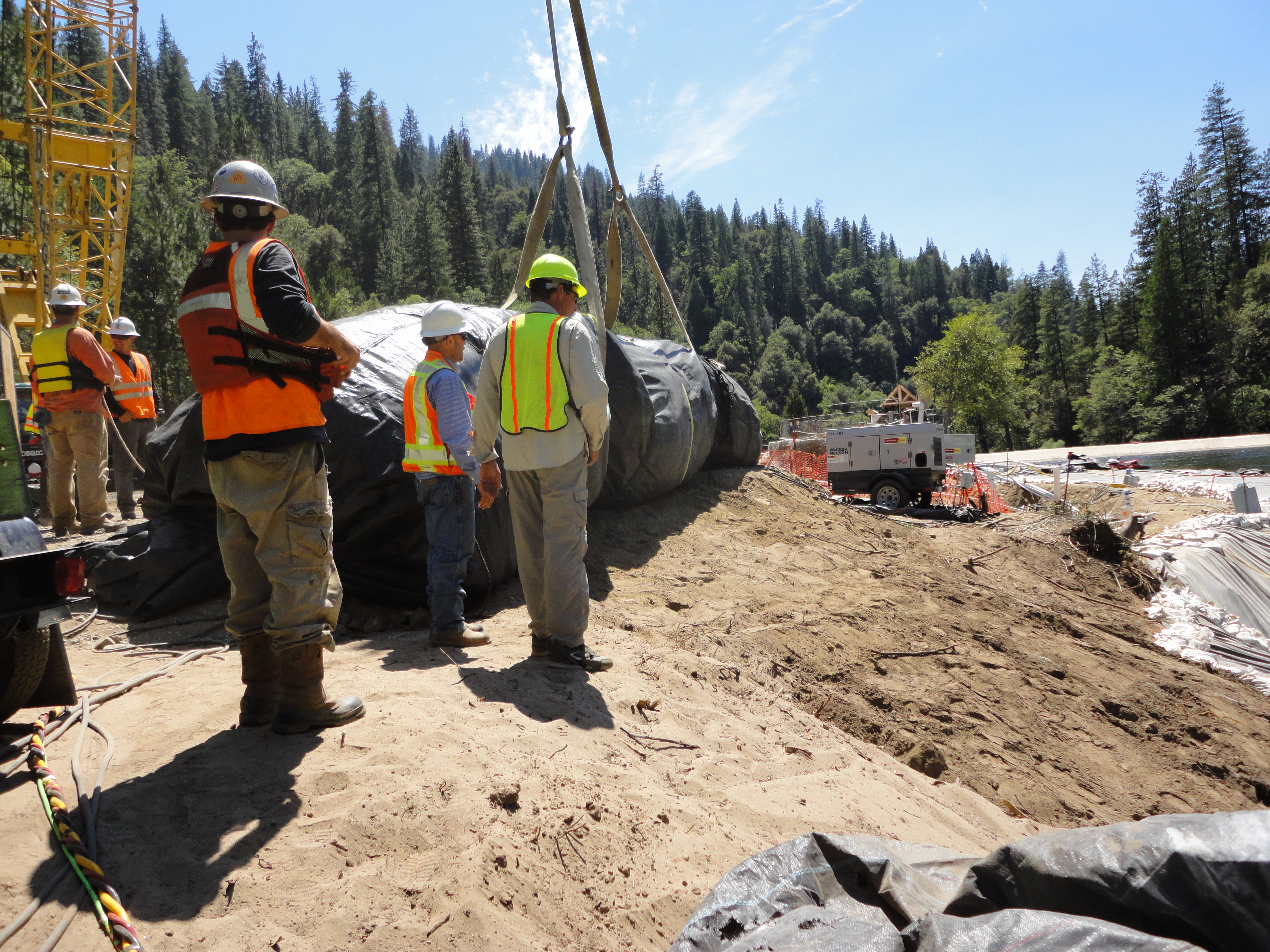
With the AquaDam® precisely positioned at the starting bank, the crane and rigging hardware were disengaged. Successful deployment requires the unit to be launched along a trajectory perpendicular to the shoreline, ensuring it enters the watercourse in a straight, controlled path to maintain proper structural integrity.
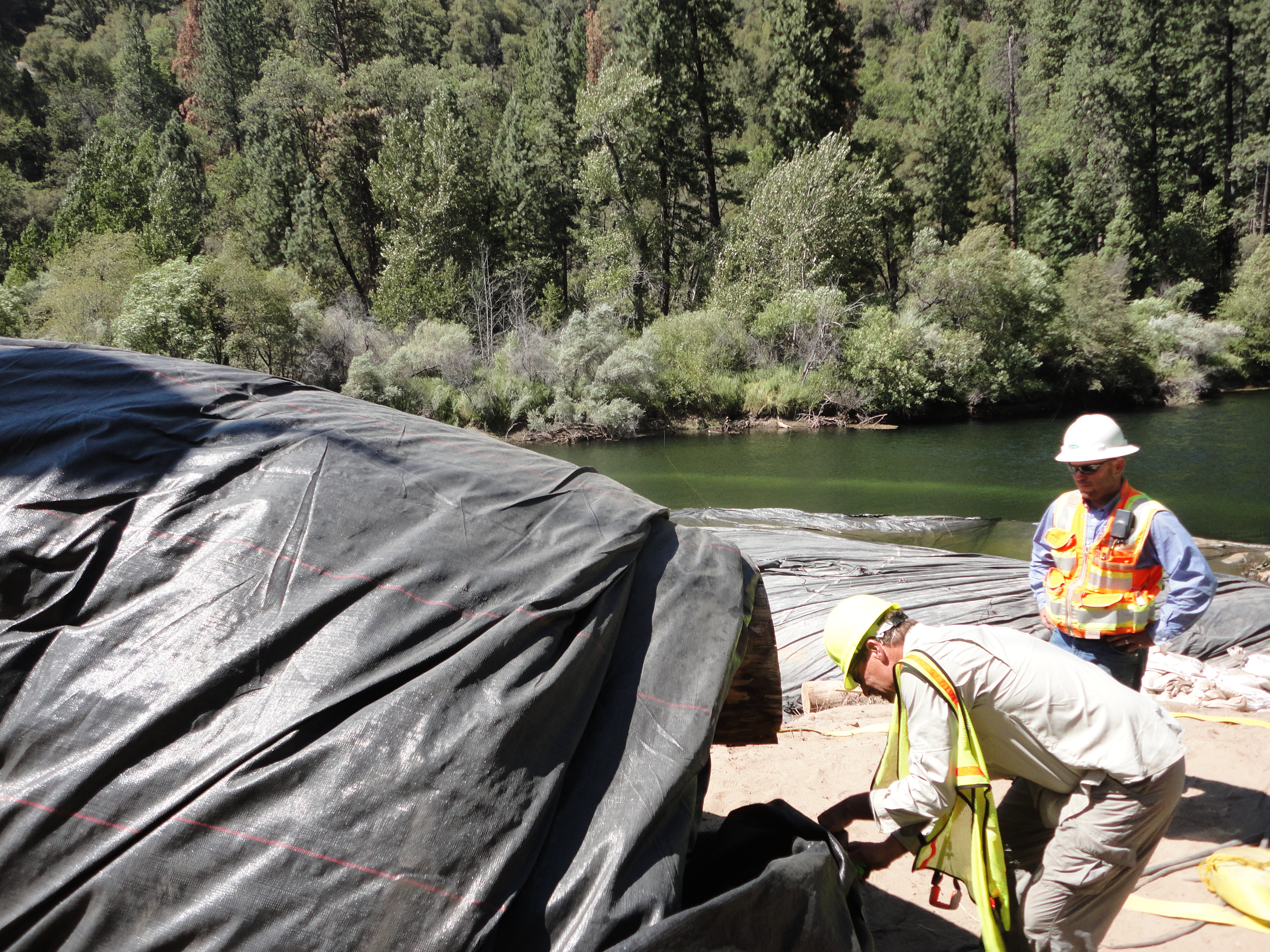
With the AquaDam® properly positioned, the crew can now remove the protective covering to access the open end.
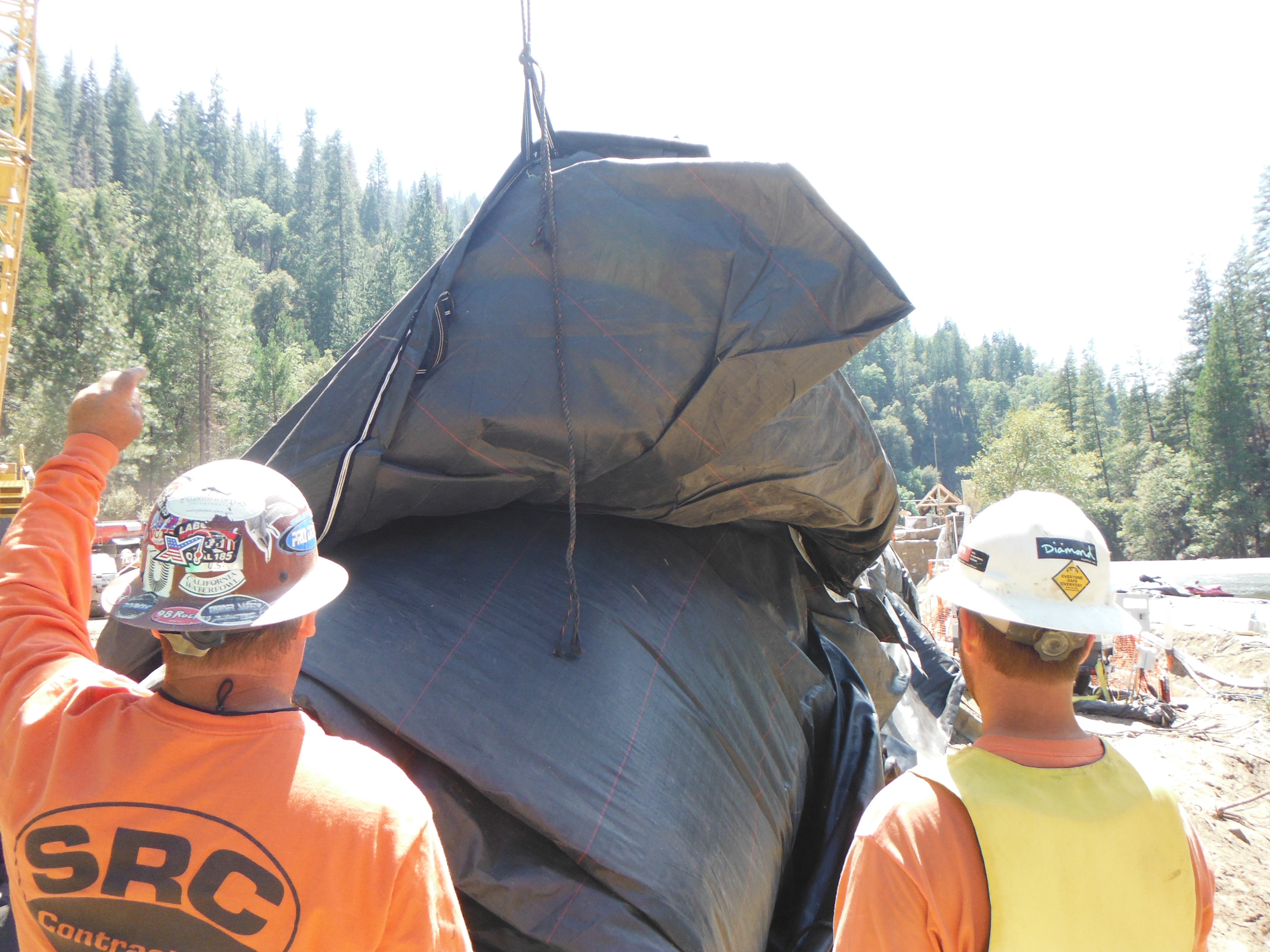
Ropes have been secured to loops sewn into the outer layer at the open end of the AquaDam® to lift and guide it off the roll.
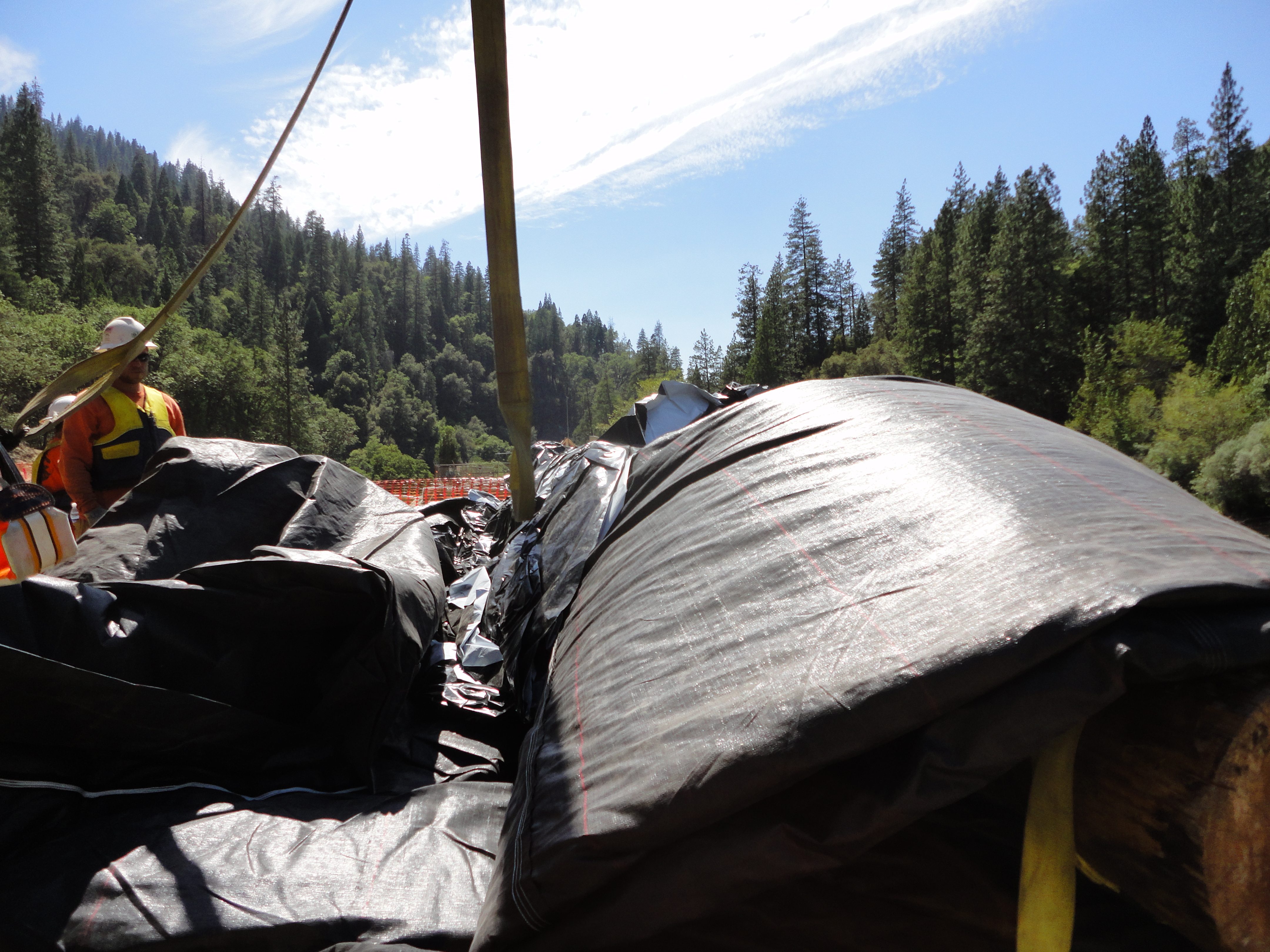
The crew now needs to unroll sufficient length of the AquaDam® to expose and access the fill-tubes.
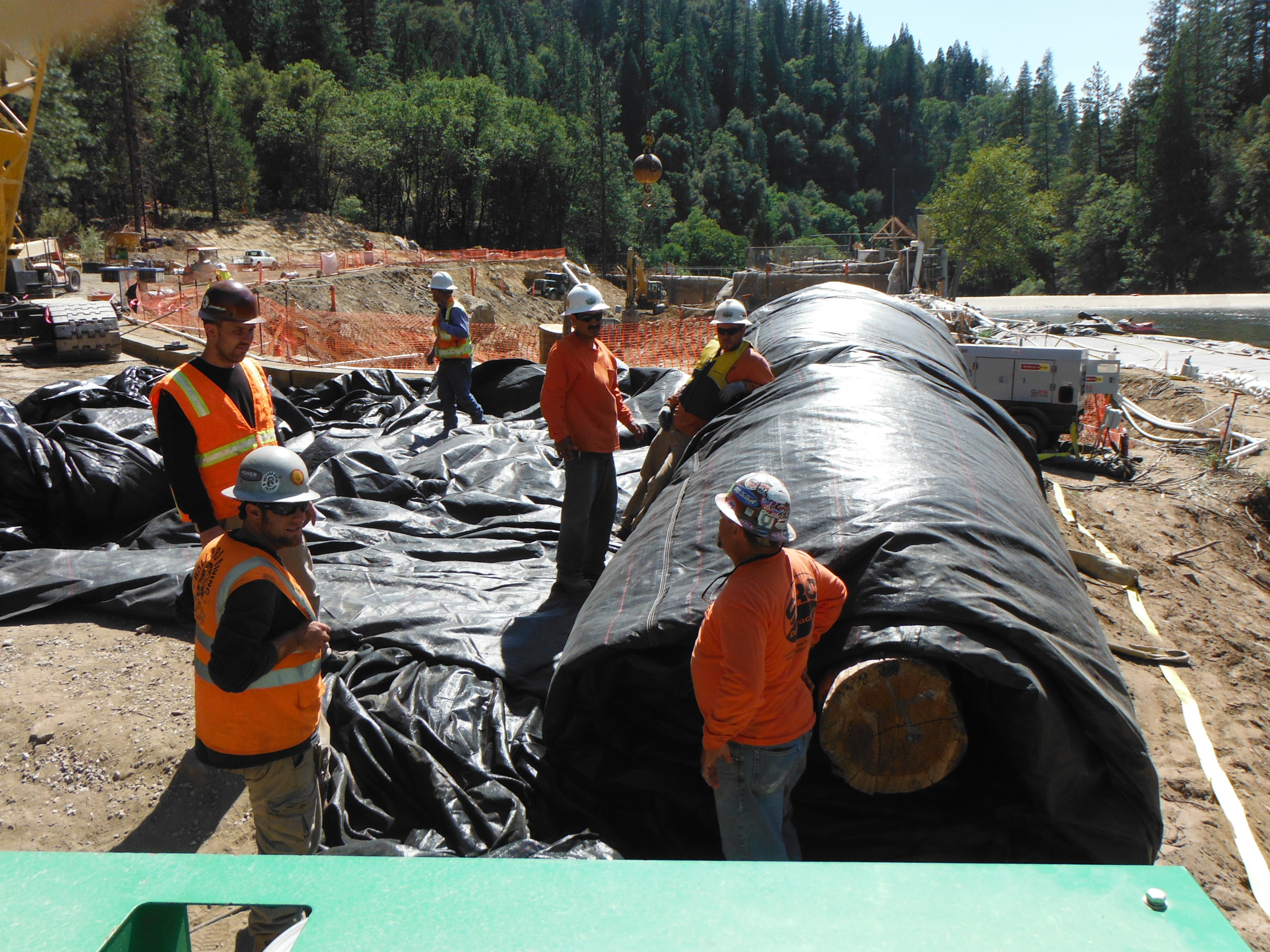
With a sufficient length unspooled, the crew is now securing the open end of the AquaDam® to established anchor points, such as tree stumps or static shore fixtures. This anchoring process is critical to counteract the hydraulic forces during the filling phase, ensuring the material remains stationary as the unit reaches its operational height.
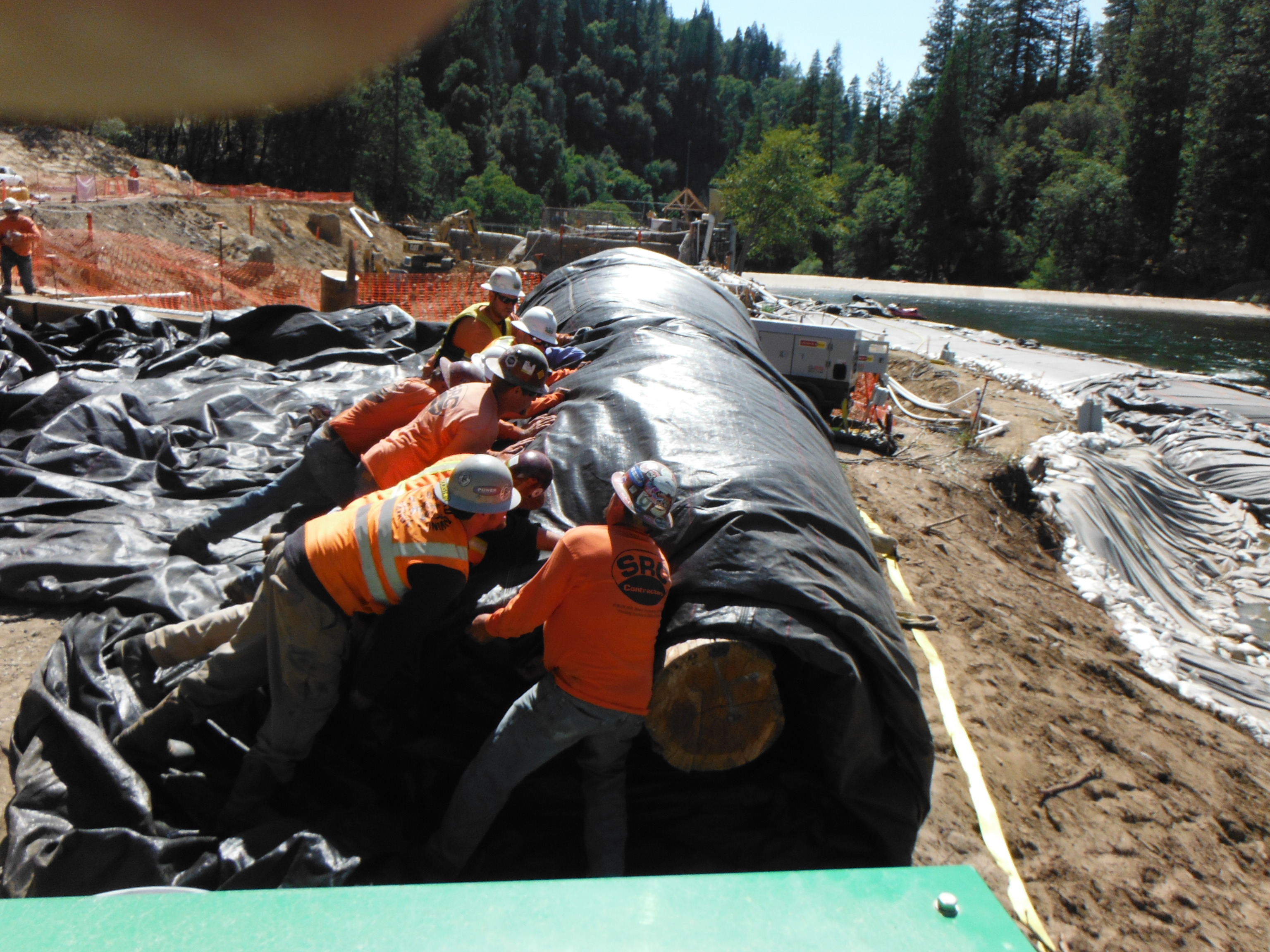
Workers push the rolled length of AquaDam® forward, guiding it down the starting bank and into the water.
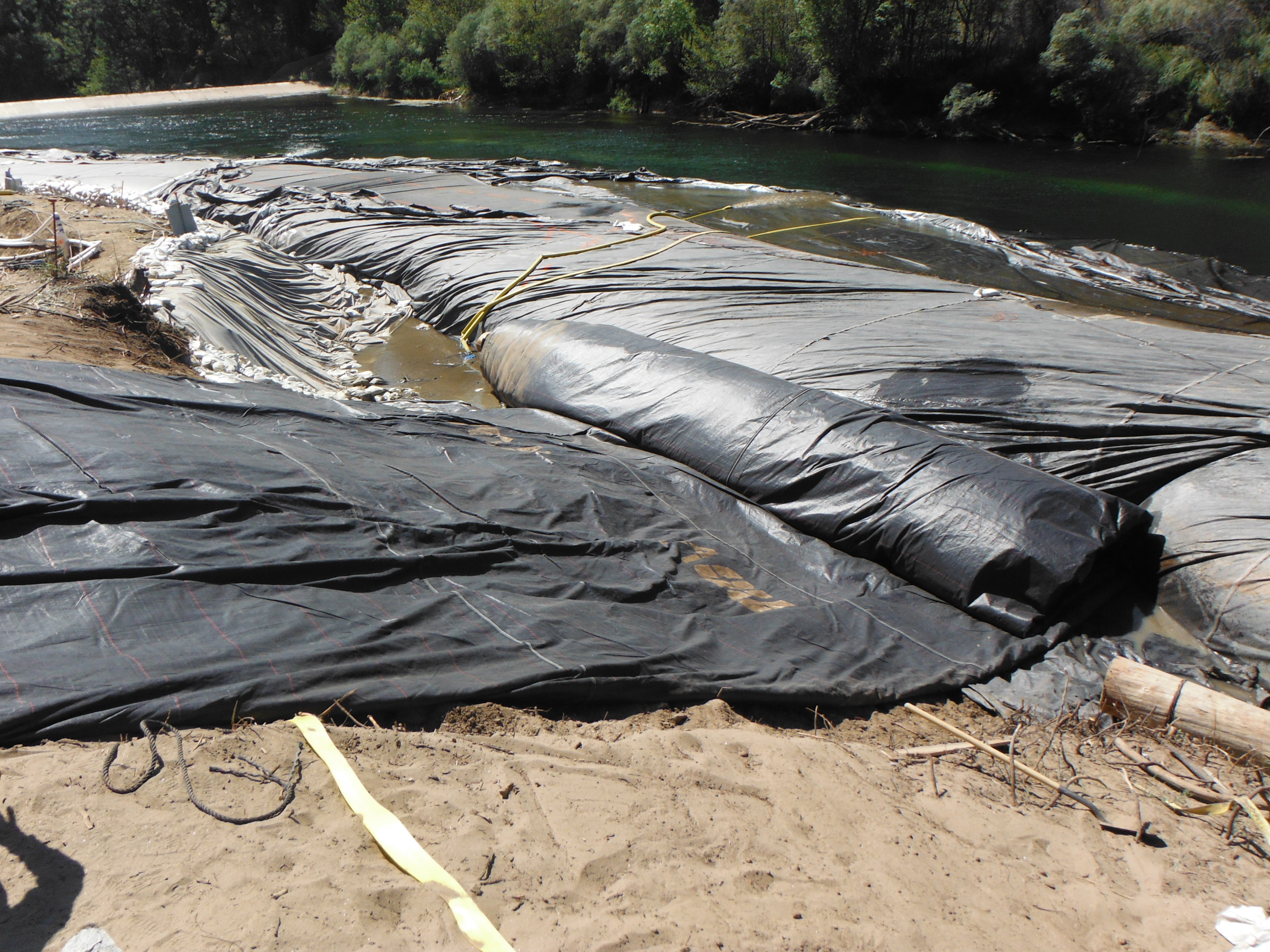
The 16ft tall SCE AquaDam® has successfully been launched into the river.
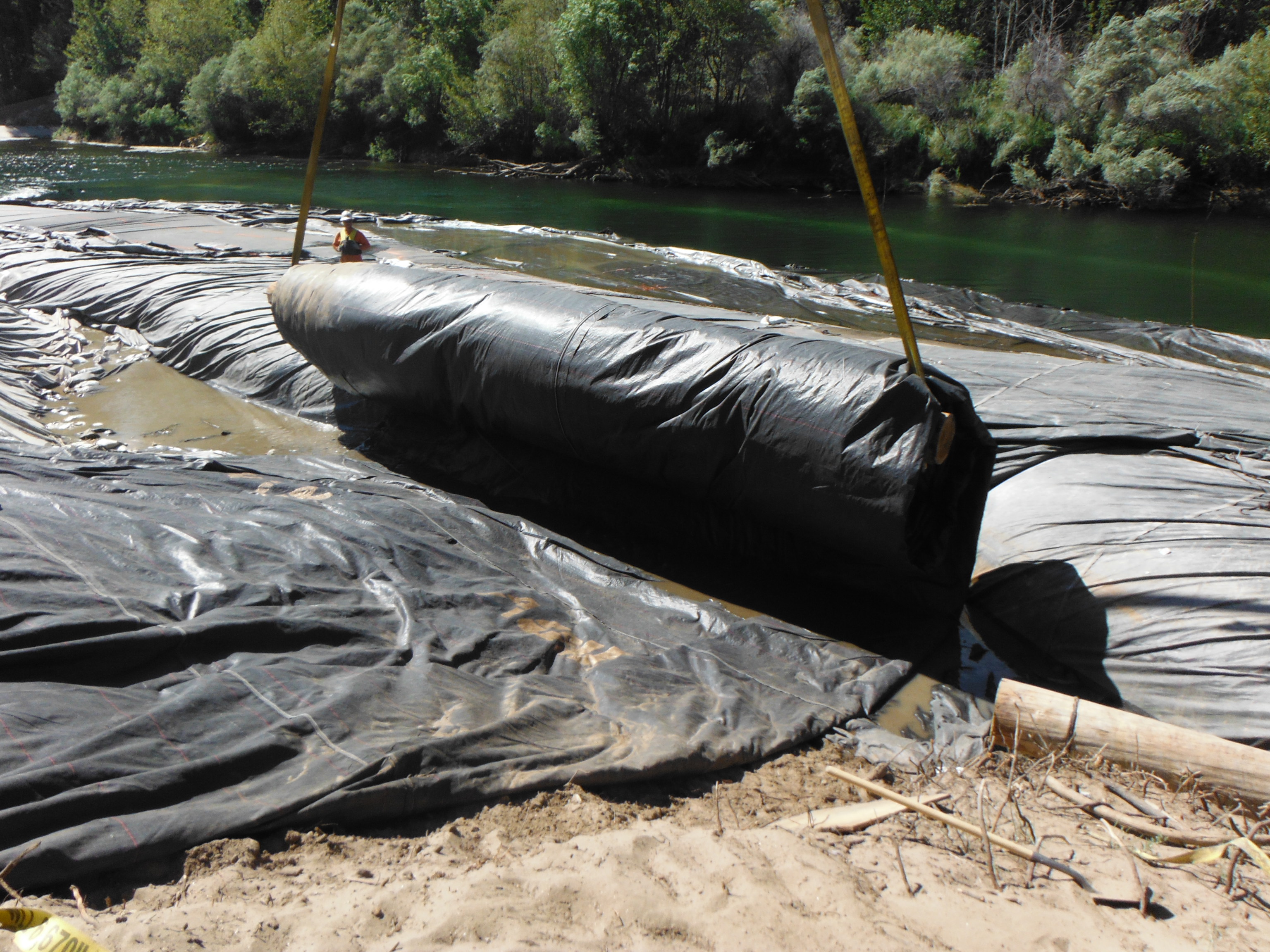
Because the original DCE AquaDam® still contained water in its single tube, the roll of the new AquaDam® had to be lifted and positioned on top of the existing dam.

Additional footage needed to be unrolled to provide enough material for the dam to lay properly down the slope of the bank. This new 16ft tall SCE AquaDam® will be installed over the top of the old unit.

The roll of the new SCE AquaDam® has been positioned atop the existing DCE unit.

With water reintroduced to the work area, the hydraulic forces from the river acting on the original DCE AquaDam® are now balanced on both sides.

Site personnel are currently extending the fill-tubes to integrate the pump discharge hoses for the hydraulic inflation phase. The 16ft SCE AquaDam® utilizes a high-integrity, five-layer composite fill-tube configuration. This system consists of three (3) layers of water-tight extruded polyethylene tubing for primary containment, reinforced by two (2) layers of high-tensile woven polypropylene for structural durability.

To ensure efficient hydraulic loading, the discharge hoses must be sufficiently recessed within the fill-tubes. This depth of insertion is critical to facilitate gravitational flow down the bank gradient, preventing localized pressure build-up at the point of origin and ensuring even distribution within the primary containment chambers.

Workers have placed two discharge hoses into this fill-tube. It is important that both fill-tubes are supplied with equal pumping power to ensure balanced and proper filling of the AquaDam®.

The crew is now preparing the second fill tube so a discharge hose can be placed inside it.

The same floating pump rig used previously to dewater the work area has now been employed to fill the 16ft tall SCE AquaDam®.

A strategic incision was made in the membrane of the legacy 16ft DCE AquaDam®. This venting procedure allows the increasing weight of the superimposed SCE unit to displace the residual ballast within the original structure. As the new AquaDam® achieves its operational volume, the gravitational load facilitates the controlled expulsion of water from the decommissioned unit.

The floating pump is operational, and the 16ft tall SCE AquaDam® has begun filling.

Workers cut several larger holes in the existing 16-ft-tall DCE AquaDam® to expedite the drainage of water from within.

This AquaDam® will soon need to make a turn and head downstream. An AquaDam® can be steered during installation to accommodate most angles. One method involves slowing or stopping the pump connected to the fill-tube on the inside of the turn, allowing the outside tube to advance more quickly and pivot the dam. Another method involves pulling on the wooden core that the AquaDam® is rolled around, using ropes attached to an anchor on shore to guide the unit into the desired alignment.

Jet skis are highly effective for pushing or pulling an AquaDam® roll when working in the water.

As the hydraulic loading progresses, the internal hydrostatic pressure within the fill-tubes exerts a constant longitudinal force against the coiled section of the unit. This pressure acts as the primary propellant, facilitating the autonomous unrolling of the 16ft SCE AquaDam®.

Evidence of asymmetrical hydraulic loading is visible, with a higher volumetric concentration in the exterior radius chamber (the right side) compared to the interior. This differential ballast is a deliberate maneuver to facilitate the planned directional transition. To further stabilize the unit’s trajectory, a rope has been secured to the log core on the interior radius, providing a mechanical pivot point that prevents the unit from drifting.

Ropes are secured to the bottom seam of the AquaDam® and anchored to the shore to hold the unit in place during filling.

The 16ft SCE AquaDam® has successfully completed its turn and is now aligned with the flow of the watercourse.

Once the unrolled section of the dam has several inches of head above the surrounding water, workers release a few feet of rope to allow additional length to unroll. They then retie the ropes and repeat this process as the dam continues to fill with water.

Installing a single AquaDam® can require thousands of feet of rope to properly secure and position the unit.

The 300ft long 16ft tall SCE AquaDam® has unrolled nearly three-quarters of the way. Although visually subtle, the unit is secured by a network of redundant ropes anchored to the shoreline.

During the deployment, the 16ft SCE AquaDam® exceeded the prescribed FERC jurisdictional boundary. To rectify this, site personnel implemented a hydrostatic equalization maneuver. By partially venting the internal chambers to match the ambient river elevation and simultaneously dewatering the work area, the crew harnessed the river’s external hydraulic head to guide the unit back into its permitted footprint.

AquaDams® are constructed from lightweight, flexible materials, allowing them to float when empty in sufficiently deep water. This flexibility enables the dam to conform to a wide range of job site conditions. To position the AquaDam® precisely, the crew employed a combination of crane, ropes, straps, manual labor, a jet ski, hand winches, and an excavator.

With the AquaDam® now positioned closer to the work area, the crew has resumed filling and unrolling the unit.

The 300-ft-long, 16-ft-tall SCE AquaDam® has nearly fully unrolled, with approximately 30 ft of material still remaining on the roll. The remaining length will continue to deploy as the AquaDam® fills with water.

A view of the starting bank following the lateral adjustment that shifted the AquaDam® away from the FERC line and closer to the shoreline. The starting end of the AquaDam® is no longer square with the bank; note the tension in the material along the left-hand side.

The 16ft tall SCE AquaDam® has now fully unrolled all 300ft of its length and has developed a couple of feet of head above the river. On the shoreline side, the water depth is much shallower, and workers have begun removing scrap materials from this area.

After monitoring the nearly full 16ft tall 300ft long SCE AquaDam®, the crew determined that adjustments were needed at the starting bank before beginning dewatering operations in the work area.

To facilitate the open end alignment correction at the starting bank, personnel inserted suction hoses into the fill-tubes to partially evacuate the AquaDam®. This reduction in internal volume was necessary to decrease the unit’s gravitational friction and restore sufficient membrane pliability, allowing the crew to manually reposition the starting section of the 16ft SCE AquaDam® into a more optimal, perpendicular orientation with the bank.

With the decision to dewater the AquaDam® and adjust the material at the starting bank, the work area will need to be refilled with water to help balance the hydraulic pressure on the dam.

As the 16ft tall AquaDam® was dewatered, the unit began to lose hydraulic head and became increasingly flaccid.

Workers must remove the discharge hoses from inside the fill-tubes and insert longer suction hoses capable of reaching deeper into the AquaDam®.

All internal layers had to be carefully aligned and properly positioned before the hoses could be replaced.

As part of the pre-insertion protocol for the extended suction hoses, the intake strainers were modified to ensure geomembrane safety. Site personnel utilized duct tape to encapsulate all high-friction metal surfaces on the suction screens. This shielding is a critical preventative measure designed to eliminate the risk of mechanical abrasion against the internal fill-tube liners.

The intake strainer must extend far enough to reach the toe of the bank at the riverbed.

The excavator played a key role in assisting with the entire process of repositioning the AquaDam®, while also helping to reduce the physical demands on the laborers.

As the pumps continue reducing the volume of water inside the AquaDam®, the crew begins cleaning the area just upstream of the 16ft tall SCE AquaDam®. This location will soon serve as the installation site for an additional AquaDam®.

The decision was made to install a 12ft tall, 25ft wide when fully filled, 100ft long SCE AquaDam® just upstream of the starting point of the 16ft tall unit. This AquaDam® was shipped rolled up like a carpet on a wooden beam, wrapped in protective covering, and equipped with lifting ropes for easier handling and placement.

With the water depth, inside the 16ft tall AquaDam® reduced, the crew was able to lift the starting end of the dam and re-angle it so that it aligned squarely with the bank.

It was critical that the lifting strap be cinched around all of the layers so they could be pulled together as a single unit. Larger AquaDams® consist of multiple internal and external layers, all of which must be engaged to ensure safe and effective lifting.

To correctly adjust the angle of the AquaDam® on the bank, equipment was used to lift the material and shift it slightly downstream. Any remaining water inside the dam was temporarily directed toward the closed end.

Lifting sufficient material up the bank and achieving the correct launching angle were critical for both a successful seal and the overall integrity of the dam.

With the material roughly in position, workers must secure the open end of the outer layer to hold it in place and then navigate through the cinched material to access the inner fill-tubes in order to begin filling the AquaDam®.

The crew must navigate through all layers to locate the fill tubes and open the inner tubing to insert the discharge hoses. The inner tubing, visible in white, measures 16ft in diameter, and the hoses must extend past the top of the bank. A 16ft tall AquaDam® includes multiple layers of both internal and external materials.

The starting end of the 16ft tall AquaDam® has been repositioned to align squarely with the bank, and water is now being pumped back into the dam.

The 16ft-tall SCE AquaDam® now rises above the surrounding water, and workers are already using it as a platform to secure tie-offs.

As the 16ft tall SCE AquaDam®nears its final fill level, the crew begins setting up the 12ft tall SCE AquaDam®.

The open end and fill tubes needed to be positioned higher on the bank. For a successful SCE AquaDam® installation, it is essential that both the open end and fill tubes remain elevated above the dam’s full height along its intended path. The AquaDam® achieves its maximum height only at the lowest point along this path.

A worker is securing the open end of the 12ft tall AquaDam® to a tree trunk. This tie-off helps ensure that the open end remains stable and does not shift during installation and filling.

Following the positioning and anchoring of the 12ft tall SCE AquaDam®, the crew is prepared to initiate the deployment of the unit down the starting bank.

Workers required some assistance to guide the roll down the bank. This section of the bank was not ideal for an AquaDam® installation; however, the crew utilized available materials to compensate for the less-than-optimal conditions. Fortunately, this unit was intended primarily to provide support for the 16ft tall AquaDam®.

Following the deployment down the starting bank, the 12ft tall SCE AquaDam® is positioned and ready for the filling phase.

Workers are positioning discharge hoses into the fill-tubes of the AquaDam®. A 12ft tall AquaDam® contains a total of eight layers of interior and exterior materials.

The discharge hose must extend past the top of the bank to ensure the water is forced down into the interior of the unit during filling.

As the AquaDam® fills with water, the internal pressure within the fill-tubes pushes against the roll end, causing the unit to unroll.

A rope is used to apply tension to one end of the log around which the AquaDam® is rolled, assisting in rotating the unit into the desired position.

The 100ft long SCE AquaDam® has nearly finished unrolling. The crew used ropes secured to the unit to help maintain its position as it filled with water.

Ropes are used to hold an AquaDam® in place while it is being filled with water; once the dam rises above the surrounding water level, the ropes can be released.

The 12ft tall AquaDam® is now nearly full. Similar to the original 10ft tall unit, this AquaDam® is equipped with DCE fill-tubes on its closed end.

At a later date, a shorter AquaDam® was installed on the work-area side at the upstream end. Excellent work by the entire crew.