Rapid Deployment Flood Barriers: Enhancing Emergency Response
Emergency managers face unique challenges when flood warnings are issued. Sandbag operations take days to deploy and require dozens of personnel who should be managing evacuations and life-safety operations. Permanent floodwalls cannot adapt when threats emerge outside their fixed perimeter.
Traditional methods are slow, labor-intensive and often fail when critical infrastructure is at stake. Explore how rapid-deployment flood barriers enhance emergency response.
Why Traditional Emergency Flood Barriers Fail in Modern Disasters
Conventional flood-control methods are not reliable for disaster response. Sandbag operations create multiple operational and financial burdens that emergency managers must address:
- Intensive labor requirements: Building a defensive line requires dozens or hundreds of personnel to fill, transport and stack thousands of bags under tight deadlines. The effort pulls emergency responders away from other critical tasks.
- Complex supply chain coordination: Sourcing and transporting large quantities of sand requires extensive coordination, and availability varies by location. Research on temporary flood protection confirms that sandbagging consumes significant time and materials while draining emergency response budgets.
- Hidden disposal costs: After the flood, contaminated sandbags can become hazardous waste, requiring toxic waste treatment and disposal fees.
The Limitations of Permanent Floodwalls
Permanent floodwalls require up-front capital, as they involve engineering, materials and often land acquisition. Once constructed, these structures cannot change. Their height, location and defensive perimeter are fixed. They cannot adapt to changing weather patterns or flood events that exceed original design specifications.
A permanent floodwall only protects against a single, predefined threat. It offers no protection if a threat emerges outside its zone, like from a water main break or flash flooding in a different area. This lack of flexibility makes permanent structures incomplete solutions for modern emergency water control.
The Benefits of Water-Filled Rapid-Deployment Barriers
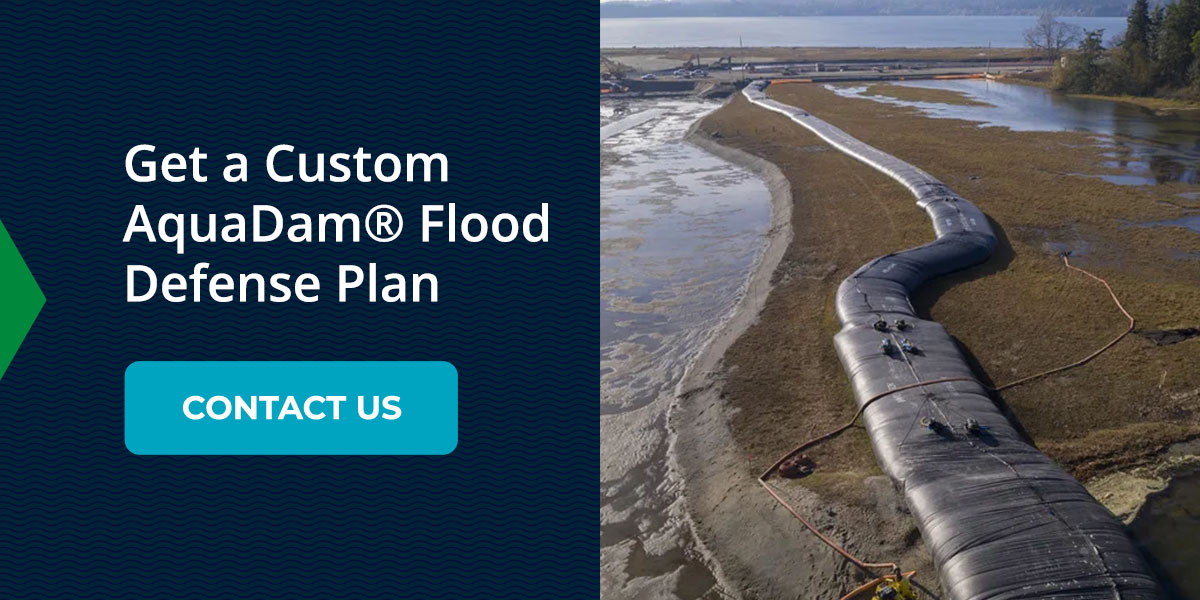
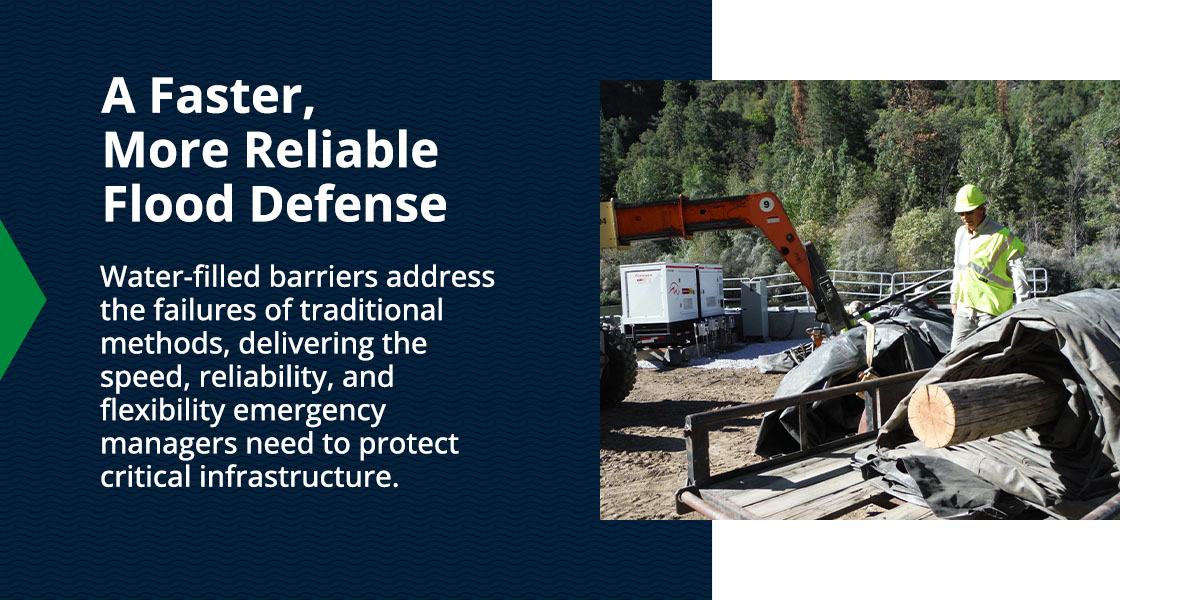
Water-filled barriers address the common failures of traditional methods. These engineered systems deliver the speed, reliability and flexibility that emergency managers need when protecting critical infrastructure.
1. Unmatched Deployment Speed
A small, trained team can deploy water-filled barriers in just a few hours. This efficiency allows emergency managers to secure perimeters well in advance and shift focus to other critical tasks like evacuation and resource staging.
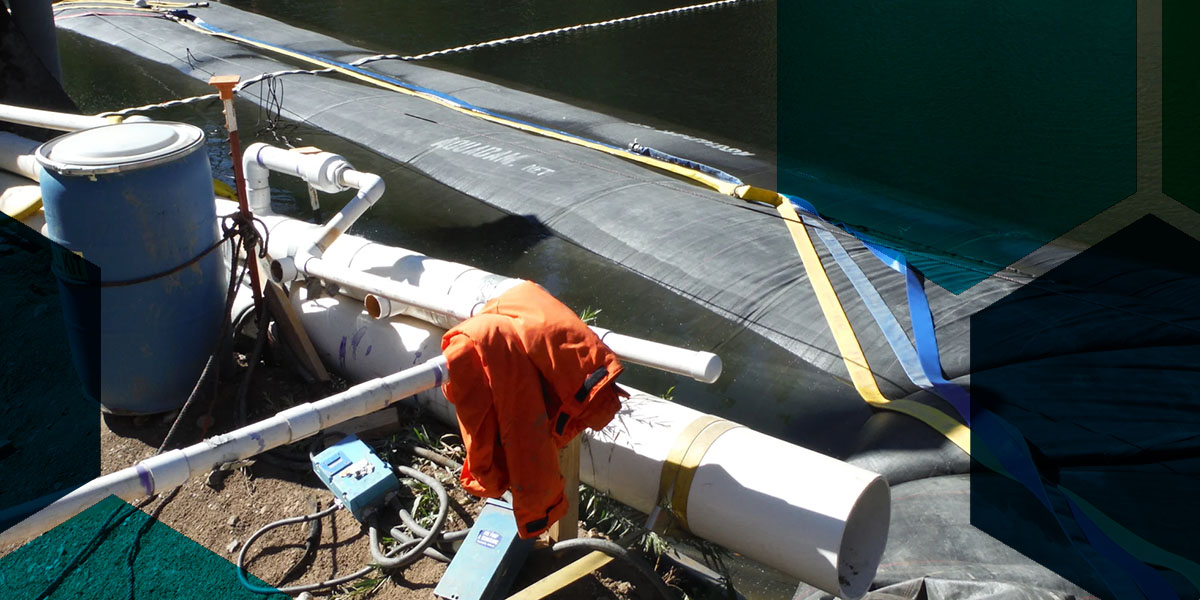
Deploying a water-filled barrier is straightforward. The process includes transporting the rolled barrier to the site, unrolling it and filling it with on-site water.
2. Reduced Labor and Logistical Strain
Water-filled barriers address several deployment challenges that strain traditional emergency response:
- Minimal crew requirements: A water-filled barrier can often be deployed by fewer people, freeing up personnel to manage evacuations, direct traffic or assist vulnerable residents.
- Reduced supply chain logistics: Traditional methods create a “materials rush,” which involves finding and transporting thousands of bags and tons of sand. Water-filled barriers eliminate this supply chain problem.
- Flexible redeployment: Water-filled barriers can be drained and moved to protect a different asset if threat assessments change. This capability allows for a flexible defense strategy throughout an evolving emergency.
3. Superior Performance and Reliability
With a sandbag wall, every seam between bags is a potential leak. On the other hand, a water-filled barrier creates a single, continuous wall with no gaps. This design can help reduce leakage and provide consistent protection along the entire length of the barrier.
The flexible materials of a water-filled barrier can also conform to the ground, settling into dips and around curves to maintain a seal. If scour or erosion occurs beneath the barrier during a flood event, the flexible dam settles into the void and maintains its seal.
4. Cost-Effectiveness
Water-filled barriers shift emergency flood protection from a recurring operational expense to a strategic capital investment:
- One-time asset vs. repeat expenditure: A sandbag operation is a recurring operational expense that must be paid for every flood event. A water-filled barrier is a one-time capital investment that can be deployed multiple times.
- Hidden mobilization costs: The recurring costs of sandbags add up. A reusable barrier’s costs are front-loaded, with each subsequent deployment requiring only minimal budget for labor and fuel for pumps.
- Eliminated disposal fees: After a flood, used sandbags are often saturated with contaminants and must be treated as toxic waste. A reusable water-filled barrier eliminates this cost.
Tips for Specifying a Rapid-Deployment Barrier
Selecting the right flood barrier system requires careful evaluation of performance standards, site conditions and operational requirements.
1. Understand Performance Standards
ANSI/FM 2510 is the definitive American National Standard for flood mitigation equipment. It is a rigorous benchmark that evaluates the performance, safety and quality of flood barriers. This standard moves beyond manufacturer claims and provides a universal measure.
Choosing a barrier certified to the ANSI/FM 2510 standard means selecting a product that has survived real-world testing by an independent third party. This testing includes evaluations for hydrostatic pressure, hydrodynamic conditions including wave action, impact resistance and material durability. Research into the effectiveness and applicability of flood barriers shows that not all systems perform equally in all conditions. Specifying certification to ANSI/FM 2510 in procurement documents can help ensure comparisons of proven solutions.
2. Assess the Site and Threat Level
Selecting the right flood barrier requires a thorough evaluation of site-specific conditions and threat characteristics:
- Water type and velocity: Determine whether the threat is slow-rising, low-velocity water from a river overflowing its banks or a high-velocity flash flood carrying debris. A thorough assessment of potential water speed and debris load is critical to selecting a barrier with appropriate durability.
- Ground conditions and terrain: The terrain along the planned defense line must be evaluated carefully. Some barrier types require a smooth, prepared surface, while more flexible systems like water-filled barriers can conform to uneven ground.
- Expert consultation: Engaging with experienced flood defense consultants is an often overlooked step. These experts can help analyze site maps, understand specific threat profiles and specify optimal solutions for unique circumstances.
3. Prioritize Scalability and Modularity
Flood threats vary, and defenses should adapt accordingly. A modular system allows the connection of multiple sections to create a continuous barrier of any required length, from protecting a single doorway to encircling an entire power substation. This ability to scale defense is crucial for creating an effective large-scale flood control plan that matches the unique perimeter of the asset requiring protection.
Get Started With a Custom AquaDam® Flood Defense Plan
Emergency managers cannot afford to rely on outdated methods that drain budgets, tie up personnel and fail under pressure.
AquaDam® understands the challenges of protecting critical infrastructure with limited resources and narrow response windows. Our team provides expert consultation to assess site-specific conditions, evaluate threat levels and design flood defense solutions tailored to precise operational requirements.
Contact us today to schedule a consultation and receive a detailed quote for a rapid-deployment system.