Successful Flood Control Initiatives Around the World
Successful Flood Control Initiatives Around the World
Flood control projects are key to protecting the 1.81 billion people living in flood-prone areas worldwide, including 600 million urban residents who face a significant annual flood hazard. Effective flood control measures must evolve as sea levels rise and weather patterns become increasingly severe. Each case study in this article demonstrates how permanent and temporary flood control solutions address unique challenges.
Large-Scale Civil Engineering Projects
International flood control efforts demonstrate how nations address complex water management challenges through infrastructure that serves multiple generations.
Netherlands Delta Works
The Netherlands has transformed flood defense into a sophisticated science, evolving from a hold-the-line approach to a forward-thinking strategy that gives water more space. The Delta Works are recognized as one of the Seven Wonders of the Modern World by the American Society of Civil Engineers. They consist of massive dams and storm surge barriers that protect the low-lying nation from flooding.
The latest evolution, Delta Works 2.0, redesigns river areas to provide waterways with additional space during high-flow periods. This ongoing adaptation reflects the reality that even advanced flood control systems must evolve to cope with accelerating sea level rise and changing precipitation patterns.
Vienna’s New Danube Relief Channel
Vienna engineered a parallel river channel as a flood overflow mechanism, representing a massive urban protection project with remarkable foresight. In 1969, the city created the New Danube, a 21-kilometer-long flood relief channel running parallel to the main Danube River. During normal weather conditions, the channel remains inactive, but when floodwaters rise, weirs activate to allow the New Danube to absorb excess water.
This design protects the city without requiring permanent alterations to the main river’s navigation. The project demonstrates how cities can integrate large-scale flood infrastructure into urban planning without compromising other critical river functions.
The Three Gorges Dam
The Three Gorges Dam is one of the largest and most powerful examples of a multipurpose hydraulic project, designed for flood control, power generation and navigation. With a flood control capacity of 22.15 billion cubic meters, the dam uses calibrated reservoir dispatching to reduce downstream flow and ease pressure on cities and communities along the Yangtze River. The dam’s ability to retain floodwaters helped reduce flood-related losses by an estimated 28–37 billion Chinese Yuan.
The project integrates monitoring technology and predictive modeling into flood-control infrastructure. Real-time data allows operators to adjust water release schedules based on upstream and downstream conditions, optimizing protection while maintaining the dam’s other functions.
Nature-Based and Integrated Flood Control Initiatives
Global flood control strategies increasingly incorporate nature-based solutions that work with natural systems rather than relying on engineered barriers. These approaches recognize that natural landscapes possess inherent flood mitigation capabilities that can be restored, enhanced or integrated into urban planning.
Rwanda’s Urban Wetland Restoration
Kigali’s wetland restoration project demonstrates how cities can successfully reclaim natural areas to combat both flooding and water pollution. The capital is restoring nearly 500 hectares of urban wetlands, the largest such project in Africa, which will benefit over 220,000 people in flood-prone areas. The initiative creates Five Wetland Ecosystem Parks featuring stormwater lakes and sports fields that intercept stormwater before it overwhelms drainage systems.
This project restores natural defenses degraded through urbanization. Rather than constructing entirely new infrastructure, the approach rehabilitates existing ecological systems that provide flood control while delivering additional benefits, including improved water quality, biodiversity habitat and recreational space.
China’s Sponge City Initiative
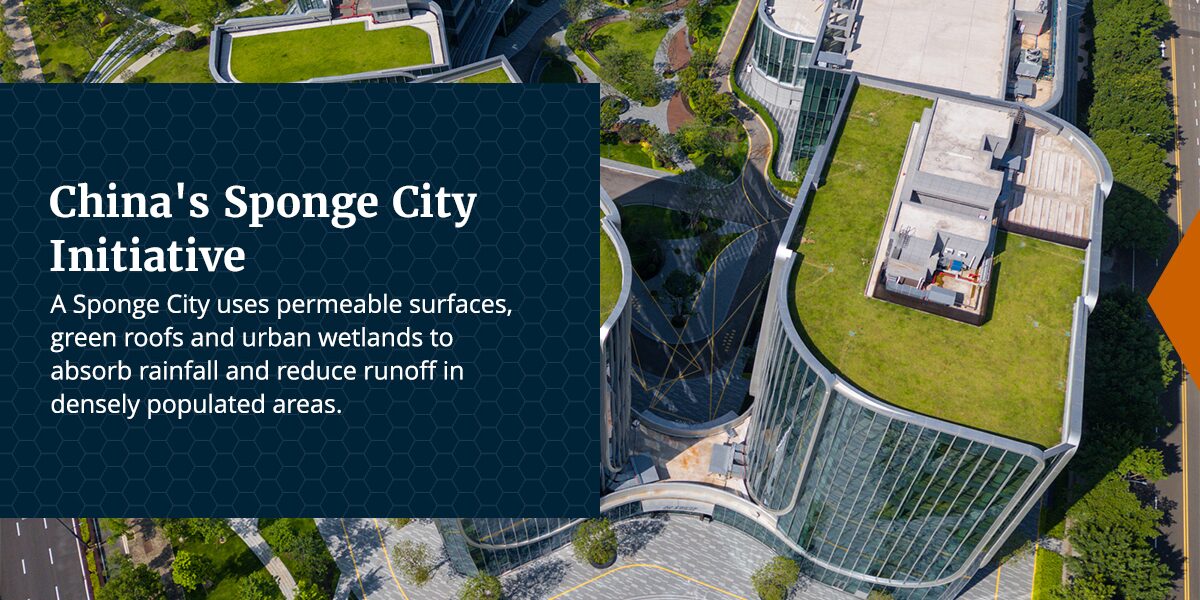
A Sponge City uses permeable surfaces, green roofs and urban wetlands to absorb rainfall and reduce runoff in densely populated areas. Cities like Shenzhen, Wuhan and Baicheng are integrating green infrastructure to manage stormwater, with goals for 80% of urban areas to absorb and reuse at least 70% of rainwater by 2030.
The approach mimics natural methods of absorbing and processing rainfall and runoff, reducing pressure on conventional drainage systems. However, there are some significant challenges. Retrofitting existing urban areas with permeable infrastructure remains expensive and labor-intensive. Additionally, green infrastructure has natural absorption limits during extreme precipitation events, requiring hybrid solutions that combine nature-based approaches with traditional drainage systems.
The Advantage of Temporary Water-Filled Barriers
Temporary water-filled barriers provide agile, effective solutions in scenarios where permanent infrastructure is under construction or requires repair. AquaDam® is the industry leader in this category, offering water-filled cofferdams that can be manufactured up to 1,200 feet long and 16 feet high.
AquaDam® for Immediate Protection
Deployment speed becomes critical when severe weather threatens populated areas. In Lakeport, California, 3-foot-high AquaDam® units were deployed to protect homes and a motel from rising floodwaters at Clear Lake. The barriers, coupled with pumps to mitigate seepage, helped minimize any flood damage.
While AquaDam® installation requires planning and proper setup, the barriers can be deployed with less labor than equivalent sandbag walls when protecting larger areas. Quick deployment is essential when time is limited and traditional sandbagging would require substantial manual labor and transportation.
Using AquaDam® to Bridge the Gap in Construction
AquaDam® units frequently protect construction sites while permanent infrastructure undergoes repair or construction. When a breach in an aging levee system in Redwood City, California, caused operational challenges requiring immediate repair, contractors deployed a 14-foot-tall, 29-foot-wide, 40-foot-long double closed-end unit installed within the washed-out section of the levee. An additional 8-foot-tall, 17-foot-wide, 156-foot-long single closed-end unit was deployed in a horseshoe configuration around the breach for structural containment, isolating the area for repair. Five cofferdams were ultimately used, with additional units placed to enhance structural stability and containment.
This application addresses a common challenge where repairs cannot wait for ideal conditions or extended planning periods. Temporary barriers allow work to proceed on realistic timelines while maintaining safety and minimizing disruption. For contractors and project managers, this flexibility translates directly to reduced downtime.
Enabling Dewatering for In-Water Projects
AquaDam® cofferdams can help create dry, controlled work environments for in-water construction and repair projects, a common requirement for bridge maintenance, pipeline installation and infrastructure inspection.
Following Hurricane Harvey’s record rainfall, which inundated Texas waterways, contractors deployed a 16-foot-tall, 300-foot-long AquaDam® with 8-foot support dams to isolate a bridge and road in Baytown, Texas, for dewatering.
This isolation allowed thorough inspection and repair of critical infrastructure. The AquaDam® installation took one day. During the install, the team discovered a boat trapped under one support dam. The AquaDam® had conformed around the boat without damage and with the seal perfectly intact.
This capability makes in-water repairs significantly more manageable by eliminating the need to work in flowing water or unstable conditions.
Get Started With AquaDam®
Resilient flood control requires permanent solutions that adapt to changing climates. AquaDam® units are ideal temporary barriers for isolating work areas during infrastructure repairs or new construction. Before storms, residents and businesses can deploy AquaDam® units more quickly and effectively than sandbags to help protect property. AquaDam® can make the longest, tallest water-filled barriers in the world, capable of protecting building sites, roads and much more. Explore our project gallery or contact us to learn more.